
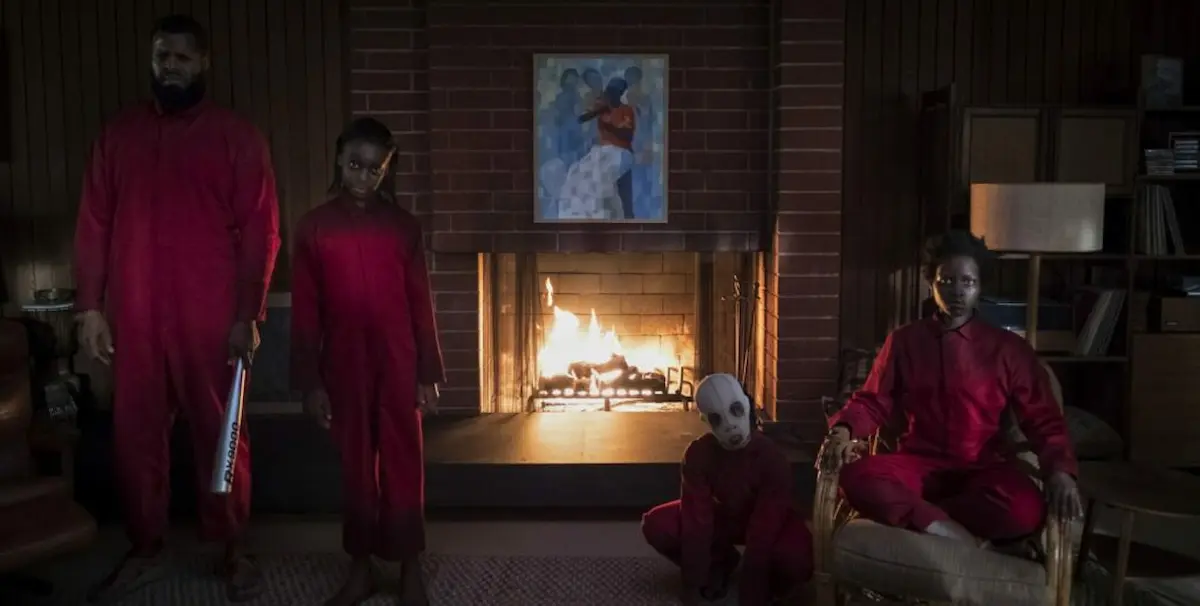
Us, a thriller that behaves like horror, is Jordan Peele’s second film after Get Out. Like that one, it has generated a great many theories online. What follows is our own reading — and a theory is by definition a point of view, not a solution.
The conscious in permanent conflict with the unconscious
The idea of the «double» recurs across psychology and philosophy. It names a division inside the human psyche, which holds both conscious and unconscious activity.
A common model splits the mind three ways: the conscious, the unconscious, and the subconscious between them. The conscious governs daily action because it operates while we are awake. The unconscious is quieter and arguably more consequential, shaping the conscious mind from underneath and surfacing through dreams. The subconscious is the bridge.
That constant traffic between the three is what the film is actually about.
Duality, inside and outside the mind
The unconscious has a poor reputation because it holds what is hardest to carry: trauma, fear, emotions that were never processed. The conscious mind is managed, and it is the version a person shows the world. One face is controlled; the other is murkier.
This duality is not confined to the brain. People behave differently with family, with colleagues, with a manager — adjusting continuously without noticing. That everyday shape-shifting is its own argument that we each carry several doubles.
Peele extends the idea outward. The film’s title is a pronoun, and it does double duty: «us» as in this family, and «U.S.» as in the country. The doubles living underground while their counterparts live comfortably above is not a subtle image, and it is not meant to be.
The doppelgängers
In folklore, a doppelgänger is a malevolent twin. Us takes that literally: the doubles are violent, frightening, and intent on replacing the humans they mirror.
But they are not simply monsters. They stand for what the conscious mind has pushed away. In the film they live in dark tunnels, cut off from the surface — an unusually direct image for everything a person prefers not to look at. Their attempt to come up and coexist ends, predictably, in conflict, which is the whole internal argument staged as a home invasion.
The detail that makes the metaphor work is that the doubles cannot speak properly. Red is the only one with a voice, and it is damaged. What has been repressed has no language — which is precisely the problem with repressed material, and why it expresses itself through action instead.
The duel
The film sets up a clean dichotomy and then complicates it: the conscious as good and healthy, the unconscious as dark and dangerous. The humans are the conscious mind, the doubles the unconscious. What the conscious represses tries to return through dreams and nightmares, and the conflict above ground runs in parallel with the one inside.
Then the ending undoes the neatness deliberately. Without spoiling the mechanism, the film asks whether the categories were ever as separate as the audience assumed — which is the more honest position, and the reason the film stays with people.
Synopsis
The Wilson family goes to their holiday home and meets up with friends, the Tylers. Strangers appear and terrorise them — and they are not the only ones targeted. Meanwhile Adelaide Wilson is troubled by buried memories that keep resurfacing, and those flashes turn out to be connected to everything happening around her. The film leaves certain areas deliberately dark.
Us is not only a horror film. It asks how we handle our own emotions, and suggests that ignoring the parts we dislike does not put them very far away.
Three scenes worth rewatching
The hall of mirrors, 1986. The opening establishes the entire film in about four minutes. Watch it again after the ending and it reads completely differently.
The driveway. Four figures standing still, holding hands. Almost nothing happens and it is the most frightening scene in the film — a lesson in what stillness does that motion cannot.
Red’s monologue. The only sustained speech any double gives. The strained voice is a performance choice carrying the film’s whole argument about who gets to speak.
Language notes
Contemporary American English, naturalistic and clear in the dialogue scenes. Suitable from intermediate upward, if you are comfortable with the genre.
The film is a good listening exercise for a specific reason: the family conversations are written to sound genuinely improvised, with interruptions, overlapping speech and unfinished sentences. That is how English actually sounds outside a classroom, and getting used to it is one of the harder steps for a learner.
Expressions worth collecting:
- «Tethered» — tied or bound to something; the film’s name for the doubles, and a useful word in ordinary contexts too
- «Creep someone out» — to make someone feel uneasy or disturbed; extremely common informally
- «Get out of here» — literally an instruction, but often an expression of disbelief, like «you can’t be serious»
- «Hold hands» — note the fixed plural: never «hold hand»; the film turns the phrase into an image