
An international meeting does not always go off the rails because participants lack vocabulary. More often it derails because the framework becomes blurred: several topics get mixed together, one person monopolises the floor, assumptions are presented as facts and nobody restates the final decision.
For the manager, the difficulty is twofold. They must follow a language that is sometimes fast and spoken with different accents, while also doing their job: sharing out the floor, protecting the relationship, bringing a decision to the surface and assigning next actions. The aim of training is therefore not to produce perfect English. It is to make the manager capable of sustaining a collective process when the pressure rises.
Key takeaway — A successful meeting is not measured by the sophistication of the vocabulary used, but by the quality of the information shared, the decisions made and the responsibilities assigned.
Why general English is not enough to run a meeting
General English helps people understand and express themselves. A meeting, however, demands more specific functions: opening an exchange, announcing an objective, interrupting with tact, asking for evidence, challenging a conclusion, comparing options and closing the discussion.
Without practice in these functions, four risks appear quickly:
- letting one person impose their own pace and interpretation;
- answering too quickly to an objection that was not properly understood;
- rephrasing again and again without converging on a decision;
- leaving the meeting with a different agreement in everyone’s mind.
The problem is not only linguistic. It also concerns the management of the interaction: who speaks, on which point, with what degree of certainty and for what purpose?
What a B2 level should enable a manager to do
The CEFR describes the learner as a social agent able to carry out tasks. At B2 level, a professional can generally follow the main points of a sustained exchange on a familiar subject, present and defend a point of view, ask for clarification and work with others to find a solution.
For a management meeting, these abilities need to be translated into observable behaviours:
- stating clearly the outcome expected from the meeting;
- distinguishing a fact, an assumption and an opinion;
- interrupting without humiliating anyone or triggering an escalation;
- rephrasing a disagreement in a way that can be worked with;
- comparing options against shared criteria;
- summing up a decision, an owner and a deadline.
An overall B2 level is therefore only a starting point. Real autonomy depends on the ability to use the language in situations close to the workplace.
The six language moments of a well-run meeting
| Moment | Management intention | Useful phrases |
|---|---|---|
| Open | Set the objective and the expected outcome | “The purpose of today’s meeting is…” / “By the end of this meeting, we need to…” |
| Frame | Separate facts from interpretations | “Here is what we know so far.” / “What remains unconfirmed?” |
| Share out the floor | Regulate turn-taking | “Let’s hear from the operations team first.” / “I’ll come back to you in a moment.” |
| Clarify | Check meaning and conditions | “When you say ‘urgent’, what deadline do you have in mind?” |
| Decide | Compare, then make the call | “The deciding factor is…” / “We’re going with option B because…” |
| Close | Assign actions and check agreement | “Who owns the next step?” / “Let me recap what we agreed.” |
This structure reduces the linguistic load: the manager no longer has to look for an improvised sentence for every difficulty. They have a small number of functions that can be reused in many contexts.
20 phrases to practise before your next meeting
Opening and framing
- The purpose of today’s meeting is… — States why everyone is in the room.
- By the end of this meeting, we need to decide… — Announces the decision the group must reach.
- Let’s agree on the agenda before we begin. — Confirms the running order up front.
- Here is what we know so far. — Puts the established facts on the table.
- Let’s separate facts from assumptions. — Stops guesses from being treated as certainties.
Regulating the floor
- Let’s hear one perspective at a time. — Prevents people from talking over each other.
- I hear your concern. Let me pause you there. — Acknowledges the speaker before interrupting.
- I’ll come back to you after we hear from the client team. — Postpones someone’s turn without dismissing them.
- Could you give us the short version first? — Asks for a summary before the detail.
- We may be talking past each other. — Signals a possible misunderstanding without blaming anyone.
Clarifying and challenging
- What evidence supports that conclusion? — Asks for the basis of a claim.
- When you say “high risk”, what do you mean exactly? — Pins down a vague term.
- I’m not convinced this option protects the deadline. — Voices doubt about a proposal in a measured way.
- I see the advantage, but we still need to address… — Recognises a strength, then raises an open issue.
- What would make this option workable? — Turns an objection into a constructive question.
Deciding and closing
- What are our viable options? — Narrows the discussion to realistic choices.
- The deciding factor is the client deadline. — Names the criterion that settles the choice.
- We’re going with option B because… — Announces the decision and its reason.
- Who owns the next step, and by when? — Assigns an owner and a deadline.
- Let me recap the decision and the open points. — Summarises what was agreed and what remains unresolved.
Two pieces of content from the corpus to move from phrase to behaviour
1. Meeting Management Challenges 1: regaining control without attacking the person
This content presents several management difficulties: dominant behaviour, a climate of intimidation, confidential commercial information, and the need to establish the cause of a problem before accusing anyone. Vocabulary alone does not resolve the situation. The manager has to open up space for people to speak, distinguish facts from interpretations and make the behaviour open to discussion without turning the meeting into a trial.
A teaching sequence can ask the learner to spot the moment when the situation “gets out of hand”, then replace a direct confrontation with three interventions: asking for a specific example, describing the observable impact and proposing the next step.
2. Meeting Management Challenges 2: clarifying priorities, workload and responsibilities
The second piece reveals another source of tension: everyone assumes the others know the priorities and expectations. A team member accepts tasks without flagging an overload; a manager stays focused on the result and discovers too late that responsibilities were not shared.
Learners can practise saying: “If you want me to prioritise the Gallagher file, which task should move?” The skill is no longer “knowing the vocabulary of priority” but explicitly negotiating order, workload and consequences.
The e-dutainment learning path in seven steps
- Diagnose — Assess the CEFR level and observe a short simulated meeting.
- Anticipate — Present the aim of the scene and have learners predict the point of tension.
- Understand — Answer a question about the facts, the people involved and what is at stake.
- Notice — Identify the phrase that changes the balance of speaking turns.
- Memorise — Review the expression in a flashcard with translation and a double context.
- Pronounce — Repeat the phrase, working on rhythm, stress and meaning-carrying words.
- Transfer — Replay the situation with a different client, a different constraint and a new decision.
This progression avoids passive viewing. The scene becomes a trigger for observation, then raw material for speaking practice.
Practical exercise: the threatened client launch
Situation: two days before an international launch, the technical team flags a quality risk. The sales lead wants to keep the date, operations asks for a postponement and the client expects confirmation before noon.
Roles
- meeting manager: must lead the exchange and announce a decision within twelve minutes;
- sales manager: protects the client relationship and the announced date;
- technical manager: refuses to go into production without an additional check;
- operations manager: proposes a fallback solution that is costly but available.
Success criteria
- the objective is announced in under thirty seconds;
- facts, assumptions and preferences are kept separate;
- each team can present its point of view without monopolising the floor;
- two options are compared against the same criteria;
- the meeting ends with a decision, an owner and a deadline.
How to measure managers’ progress
| Dimension | Observable behaviour | Operational indicator |
|---|---|---|
| Framing | Announces objective, scope and expected outcome | Fewer digressions and off-topic items |
| Interaction | Interrupts, redistributes the floor and clarifies with tact | More balanced participation |
| Precision | Distinguishes facts, assumptions and conditions | Fewer misunderstandings and false agreements |
| Decision | Compares options against an explicit criterion | Decision understood by participants |
| Closing | Summarises actions, owners and deadlines | Complete and verifiable action plan |
The number of phrases memorised remains a secondary indicator. The central measure is the ability to complete the task under time pressure.
Frequently asked questions
Do you need to be C1 to run a meeting in English?
Not necessarily. A B2 level can provide enough autonomy for many professional meetings, provided you train the functions that are actually used: framing, clarifying, challenging, deciding and summarising. Highly political, legal or technically complex meetings may, however, require greater precision.
How can you interrupt without appearing aggressive?
Acknowledge the message before taking back the framework: “I hear the urgency. Let me pause you there so we can verify one point.” The interruption targets the process, not the person.
Why use film scenes rather than teaching dialogues alone?
A scene makes the pace, the hesitations, the power relationships and the reactions of the other speakers visible. A teaching dialogue remains useful for isolating a structure, but the scene helps learners understand when and why to use it.
Can the programme be adapted to each job?
Yes. Meeting functions are common to all, while the scenarios, risks, evidence and decisions change depending on sales, finance, purchasing, management or project management.
Training people to lead the exchange, not just to speak
Effective training must bring the language level closer to the performance expected at work. For a manager, being able to speak is not enough: information has to circulate, the relationship has to be preserved and the discussion has to be turned into collective action.
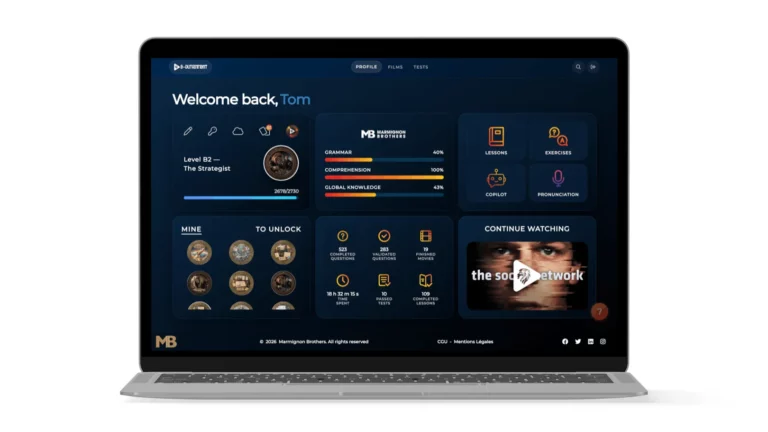
e-dutainment makes it possible to combine contextualised videos, interactive questions, flashcards, pronunciation, simulations and blended support around the critical situations a company faces.
Assess your managers’ language needs and request a demonstration of the e-dutainment Business English programme.
Sources and references
- Council of Europe – CEFR Companion Volume — Descriptors for interaction, mediation and collaboration.
- e-dutainment – Professional English training for companies — Personalised pathways, CEFR assessment and blended learning.
- Teaching source: Learning resources developed by Marmignon Brothers for the e-dutainment app and the English training courses offered by the organisation.