
Learning English with e-dutainment: a different way to learn a language
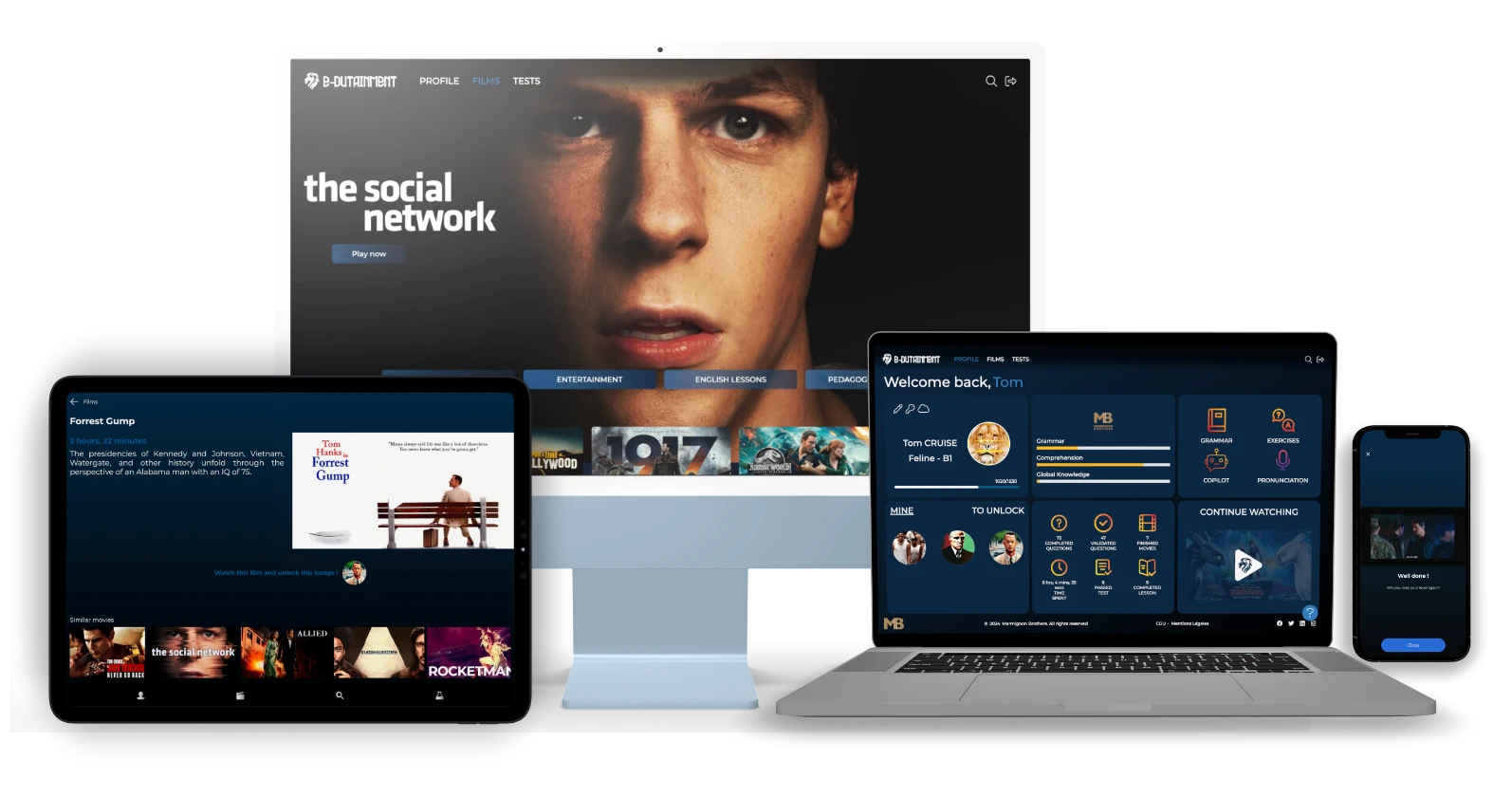
e-dutainment is an application built on a simple observation: emotion fixes memory. Designed by a French start-up, our method replaces the classroom with the spectacular. Learning English stops feeling like an effort and becomes an immersion.
Why learn English through cinema?
The brain does not retain what bores it. That is why interaction sits at the heart of the method. Whether the goal is general or professional English, the secret lies in authentic exposure — not in repeating sentences nobody would ever say.
By learning English with films, you expose your ear to real life. You absorb the structures of the language, its pronunciation and its vocabulary as they are actually spoken — with the speed, the contractions and the hesitations that textbooks quietly remove.
That is also why progress feels different here. You are not memorising a list; you are recognising something you have already heard, in a scene you remember.
The science behind the pleasure
A method supported by neuroscience
Learning a language is a question of biology. Neuroscience shows it: emotion is the cement of memory.
When you laugh at Friends or shiver watching Inception, your brain releases dopamine, which supports memorisation.
Unlike traditional courses, e-dutainment keeps your brain alert. You associate a word with an image, so your vocabulary grows and transfers quickly to real situations at work.
A playful method with interactive content
Want to understand the method? It combines play and immersion — two things traditional courses treat as opposites.
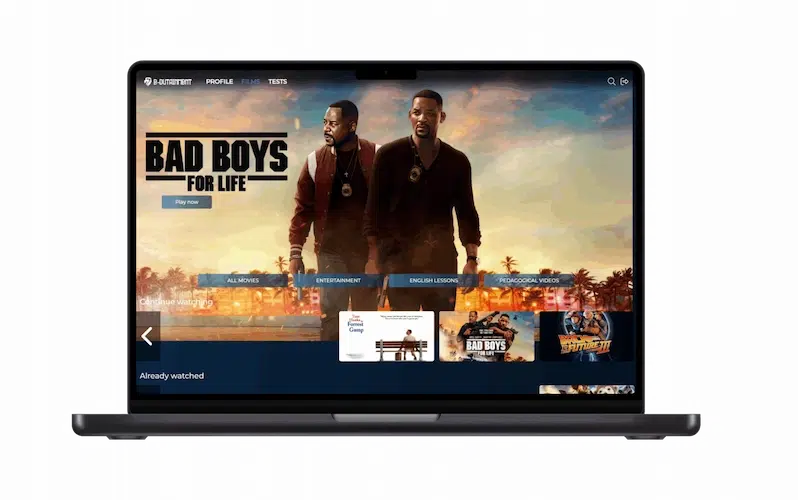
To make that possible, we work with major studios including Universal, Sony and Paramount. That access is what lets us turn real films and series into structured learning material, rather than reconstructing pale imitations of them.
Each clip is chosen for what it teaches: an idiom in context, a register shift, an accent worth getting used to. Nothing is included simply because it is famous.
You watch official clips in HD. That quality matters more than it sounds: a clear soundtrack is what lets the ear separate words that run together in ordinary speech.
The platform adds instant quizzes on what you have just heard. The content becomes interactive: you stop being a spectator and start being asked to prove you understood.
Practical exercises then confirm that the content has been absorbed rather than merely recognised — the difference between understanding a line and being able to use it.
Voice technology to progress in speaking
Beyond the films, technology is what makes speaking possible. The platform includes voice analysis tools that work on pronunciation the way a coach would — by listening, comparing and correcting.
Most learners understand far more English than they dare to speak. This part of the method exists to close that gap.
L'écoute active
You hear an actor deliver a famous line with a native accent.
Repetition
You record your own voice repeating the line.
AI feedback
The system compares your pronunciation with the original and corrects you immediately.
“This approach breaks the fear of sounding ridiculous, and finally gets people speaking English.”
A structured programme leading to a recognised certification
Enjoyment and seriousness are not opposites. e-dutainment is a genuine professional programme built to strict standards, and it leads somewhere: an internationally recognised certification such as TOEIC or English 360.
A certification matters for one practical reason. It turns a level you feel into a level someone else can verify — a recruiter, a client, a head office in another country who was never in the room while you learned.
These certifications are recognised by employers internationally. They exist for one reason: to make progress measurable and a level verifiable by someone who was not in the room. Without that, «I speak English» remains an opinion.
A personalised path for every learner
Every brain is different. The path adapts to each profile:
Adaptabilité
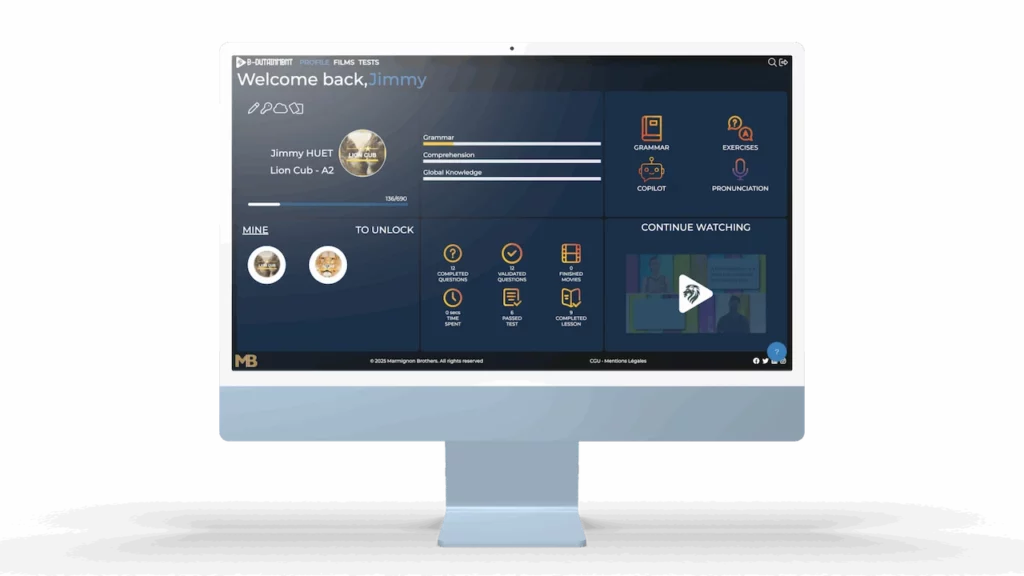
The algorithm analyses your mistakes and serves the revision content that matches them, so you spend your time on what you actually get wrong rather than on what you already know.
Pertinence
It recommends the videos, films and series that match your current level and your line of work — a hospital drama for a healthcare profile, a courtroom scene for a legal one.
Coaching Humain
For those who want it, the digital path is completed by coaching sessions with an expert trainer, who works on the situations an algorithm cannot rehearse with you.
For companies: training that fits into your development plan
In corporate training, effectiveness is what counts. Our solutions are not limited to individuals — they are designed to slot into a company’s own development plan.
Programmes are delivered in-house or remotely, in groups or individually, and are built around the situations your teams actually face.
- Aligned with your field: specific vocabulary for business, tech or medical work.
- Goal: a genuine, recognised professional qualification.
English programmes and certifications (TOEIC & English 360)
Having fun is serious business. e-dutainment is a genuine professional programme built to strict standards, and it ends with something verifiable: preparation for a recognised certification such as TOEIC or English 360.
Which one suits you depends on the objective. The TOEIC is the reference most employers already know how to read. English 360 assesses the four skills in a fuller, more conversational way.
The TOEIC ® test
The reference for professional English, and the score most employers already know how to interpret.
The English 360 certification
A full 360° assessment covering listening, speaking, reading and writing, for a picture of the level that a single score cannot give.
Classroom method vs the e-dutainment method
F.A.Q
Frequently asked questions about our method
Is it really effective for professional English?
Yes. Learning a language in context is what makes it stick. Our programmes also include dedicated business English modules. Forget standardised lessons — the path is built around your situations.
Can my company pay for the programme?
Yes, and most do. Companies usually cover it from their own training budget. Tell us the number of people and the objective and we will send a quote.
What level do I need to start?
The method is adaptive. Whether you are a complete beginner (A1) or advanced (C1), the videos adjust to you. You progress step by step against the Common European Framework — on listening comprehension, for instance.
What is the difference between the method and the certification?
e-dutainment is the day-to-day method — English through films and series. English 360 and the TOEIC are the examinations taken at the end.
How much time per day does it take?
Regularity beats duration. Fifteen minutes a day is worth more than two hours once a week. The short format is designed for full calendars, with clips of varying length.
How do I get access?
Get in touch and we will set up your placement test. You then get access to the platform and to your personalised lessons.
Is the programme available outside France?
The platform is currently available to users located in France. If your team is based elsewhere, contact us — we will tell you what is possible for your country.
Will I actually speak English by the end?
Yes — the goal is operational, not academic. Voice recognition and role-play mean you work on speaking from day one, alongside everything else the films and series bring.
Which studios do you work with?
We work with major names in cinema, which guarantees HD picture and sound — essential for training the ear.