
Preparing for the TOEIC is no longer a matter of working through multiple-choice papers until something sticks. Getting a score that means something — and that reflects English you can actually use — takes a combination of test preparation, listening, reading, consistent practice and a course that matches where you are starting from.
Why the TOEIC is still a reference point
In a labour market where working English is a concrete advantage, the test designed by Educational Testing Service (ETS) remains one of the most widely used instruments for assessing an operational level.
The TOEIC places a candidate’s language skills inside a recognised framework, particularly for listening, reading, professional English and international communication. It covers profiles from beginner to advanced — A1 to C1 on the CEFR scale.
For most learners, taking the TOEIC is not only about validating a stage. It structures a progression and produces legible evidence of a level. Preparation becomes genuinely useful when it sits inside a project: internal mobility, an application for an English-speaking role, a move into an international function, or returning to study.
A good TOEIC score is not an absolute guarantee of performance in a real situation, but it is a reassuring signal to recruiters and HR. The task, therefore, is to choose preparation that takes the test seriously while building English you can use outside it.
Structuring effective preparation
Good TOEIC preparation depends on regularity. Working with qualified teachers in an organisation that specialises in exam preparation helps, but the shape of the practice matters more than the setting.
What has to be worked on: listening comprehension, fast reading, professional vocabulary, the grammatical structures that recur, and time management.
The multiple-choice format can look simple, and it is not. It requires spotting distractors, processing instructions quickly and holding concentration across a full session. Passing well means combining explanation, targeted exercises and practice under real conditions.
Preparation also has to include concrete professional situations: a client exchange, a meeting, travel arrangements, an email, an announcement, an instruction, a voicemail, a presentation. This is where online learning becomes genuinely valuable — provided it is not just a series of quizzes. Formats that combine authentic content, repetition, speaking, reading and progressive assessment prepare you for the test while actually improving your English.
Why authentic content matters
Learners give up when training reduces to mechanical exercises. To progress, you also have to hear English as it is genuinely used: different accents, natural speed, professional expressions, indirect phrasing, workplace vocabulary.
Authentic audio and video build the listening capacity the test measures and familiarise you with the communication situations that recur across English tests. That is even more true if you are aiming at TOEIC Speaking & Writing, which assesses production alongside comprehension — validating all four skills requires broader immersion.
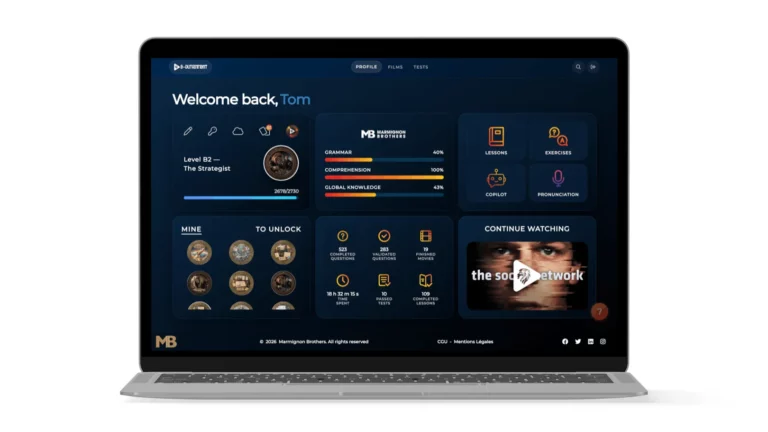
This is where an approach like e-dutainment’s is useful: English worked from audiovisual context, with flashcards, tests, exercises and a progressive pathway. The point is not to replace test-specific practice but to make the practice regular and closer to real professional situations.
Choosing a course
Before committing to a programme, compare: which certification it prepares, the starting level, the target level, trainer support, the platform, flexibility, the number of hours, cost, assessment arrangements and how the test itself is booked.
A serious TOEIC course does not promise an unrealistic score. It explains how it intends to get you to a realistic one, and it is specific about which version of the test it prepares — TOEIC Listening and Reading is the best known, but it is not the only one.
The TOEIC is not an end in itself. It is a marker inside a wider development path, and the course should be chosen against your professional objective and your learning pace rather than against price alone.
Building a realistic schedule
Preparation works considerably better when it is planned several weeks ahead of the test date. Alternate listening, reading, professional vocabulary and timed practice rather than compressing revision into a few days.
A workable week might be two short listening sessions, one fast-reading session, one on recurring grammar points, and one full mock test. That regularity reduces stress and makes recurring errors visible.
Tracking matters too. Recording your scores, the question types that give you trouble and the vocabulary areas to revisit turns preparation into something measurable — which is particularly useful if you need to evidence progress to an employer.
Finally, distinguish practice from progress. A mock test tells you your score on that day. The training also has to build reflexes: listening faster, reading more efficiently, spotting the essential information, and reusing professional vocabulary. That combination is what gives the certification its value.
→ Prepare for the TOEIC with e-dutainment.
Sources and references
- Teaching source: Learning resources developed by Marmignon Brothers for the e-dutainment app and the English training courses offered by the organisation.