
Business English has become a baseline professional skill. Whether you want to hold your own in a meeting, handle an interview in English, or certify your level formally, command of English in a professional context opens doors that stay closed otherwise. This guide covers the methods, the practical shortcuts, and how to structure learning around a working schedule.
Why business English matters
English is the working language of international business. In a modern professional environment, command of it in concrete situations is what makes the difference — international meetings, negotiations, emails, client calls, presentations.
International mobility. Depending on your sector, a solid level of business English determines access to senior roles and to assignments abroad.
Competitiveness. Being able to handle an interview in English has become a selection criterion in many sectors. A certified level distinguishes a profile in a way self-assessment does not.
Working with international teams. Communicating in English at work is a daily reality for a growing number of employees, including those who never travel.
Career progression. Most managerial, technical and strategic documentation worth reading is written in English first.
Assess your level before choosing anything
Before picking a course or a method, establish where you are. Learning business English does not start from the same place for a beginner, an intermediate learner, and someone already operating at a good level.
- A placement test against the CEFR scale (A1 to C2) to measure your current level in both writing and speech
- A self-assessment by area — listening, speaking, writing — to identify which skills to prioritise
- A mock certification (TOEIC, Linguaskill) to see your professional English under conditions close to the real test
Assessing properly lets you build a programme around your actual level — and avoids restarting from the basics when you already have a solid foundation.
Methods that work
Immersion in authentic English. Learning to speak in real situations is more effective than exercises out of context. Films in their original version, professional podcasts, and genuine business content anchor vocabulary differently from a word list, because the vocabulary arrives attached to a situation.
Vocabulary notes, used properly. Vocabulary sheets remain useful for memorising the key expressions of your sector — finance, law, marketing. Combined with spoken exposure, they accelerate acquisition. Used alone, they produce recognition without recall.
Foundations in context. For beginner and intermediate learners, consolidating the basics inside a professional context — formal written grammar, the common tenses, sentence structure — takes priority over specialised vocabulary. Technical terms are useless inside broken sentences.
Practical shortcuts
- Watch your favourite films in English with English subtitles, not subtitles in your own language
- Read the English-language press in your sector every morning
- Repeat aloud — speaking improves only through speaking
- Work for 20 minutes a day rather than three hours at the weekend
The last one is the one that decides outcomes. Language acquisition responds to frequency far more than to duration, and a routine that survives a busy week beats an ambitious one that does not.
Setting a target that means something
«Fluent» is not an objective; it cannot be measured and it never arrives. Useful targets look like: reaching B2 on the CEFR scale, running a client meeting without preparation, writing a proposal without having it reviewed, or reaching a specific TOEIC score.
A defined target also tells you what to stop doing. Someone who needs to present in English does not need more reading practice, and someone preparing for a certification needs the specific format, not general conversation.
Essential business English vocabulary and phrases by situation
Vocabulary sticks better when it is tied to a situation you actually face at work. A few starting points for the four contexts that come up most often:
Meetings. “Let’s get started”, “Can we circle back to that point later?”, “I’d like to build on what you just said”, “Let’s park that for now and move on”, “To summarise, we agreed that…”.
Emails. “I’m writing to follow up on…”, “Please find attached…”, “Could you confirm by [date]?”, “Let me know if you need anything else in the meantime”, “Looking forward to your feedback”.
Negotiations. “What flexibility do we have on…?”, “That works for us, provided that…”, “Let’s find a middle ground”, “I’ll need to check internally before confirming”.
Presentations. “Today I’ll walk you through…”, “Let’s move on to the next point”, “I’ll pause here if there are any questions”, “To wrap up…”.
None of these phrases are difficult English. What makes them useful is repetition in context — using the same handful of expressions across real meetings until they come out without translation in your head first.
Do you need a certification too?
If part of your goal is to prove your level formally rather than just improve it, the certification landscape (TOEIC, TOEFL, Cambridge, Linguaskill, IELTS — and where English 360 fits in) deserves its own look rather than a quick summary here: see our full guide to English certifications: which test to choose.
FAQ — Learning business English
How long does it take to reach a professional level in business English?
It depends entirely on your starting point. Moving one CEFR level (for example B1 to B2) typically takes somewhere between 100 and 200 hours of effective practice, faster with regular exposure to authentic content than with occasional study.
Is general English enough, or do I need business English specifically?
General English builds the grammar and structure business English relies on, but professional vocabulary and situations (negotiating, presenting, writing formal emails) need to be practised on their own — general fluency does not automatically transfer to a boardroom.
Can I learn business English without traveling or attending in-person classes?
Yes. Distance learning with a dedicated trainer and authentic content (films, real business documents) covers the same ground as in-person training, and removes the scheduling and travel constraints that make regular practice hard to sustain.
What’s the fastest way to prepare for a specific meeting or interview in English?
Targeted preparation beats general revision: identify the vocabulary and phrasing specific to that exact situation (see the phrase list above), rehearse it aloud, and focus less on grammar perfection than on being understood clearly under time pressure.
Learning with e-dutainment
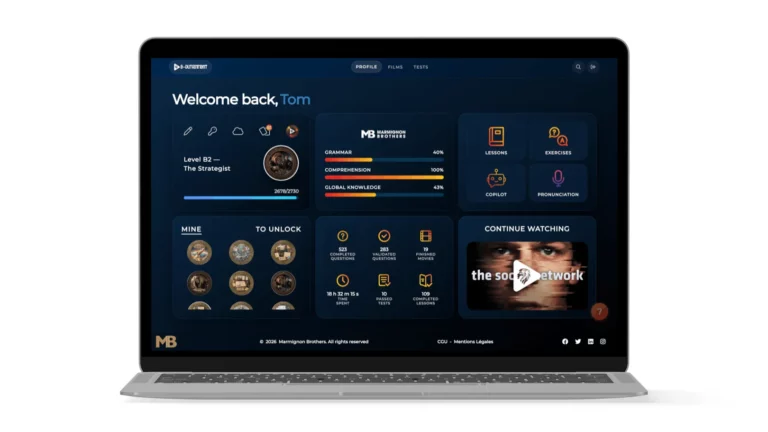
The e-dutainment method builds learning around complete films in their original version — real accents, natural pace, professional and everyday idiom — so that what you practise resembles what you will face.
Business English, general English and certification preparation all run inside the same framework, with each pathway built around your starting level and your professional objective. Courses are delivered by Marmignon Brothers, a training organisation certified to the French Qualiopi quality standard, and are available internationally by distance learning.
→ Discover our professional English training, or go straight to a certification path: TOEIC preparation or the English 360 certification.
Sources and references
- Teaching source: Learning resources developed by Marmignon Brothers for the e-dutainment app and the English training courses offered by the organisation.