An English certification has become a standard part of professional life. Whether you are an employee wanting to validate your level of professional English, or a company assessing your teams’ English skills, certifications provide an objective reference point. But faced with TOEIC, TOEFL, Cambridge, Linguaskill and IELTS, which one should you actually choose? This guide sets out the main options and what each is for.
What business English certifications measure
Recognised English certifications attest to a language level in a standardised way, using the Common European Framework of Reference for Languages (CEFR). An English proficiency test gives an objective picture of listening, reading, speaking and writing in professional or academic contexts, and works as formal proof of English for an employer, a university or an immigration file.
The most widely used are:
- TOEIC (Test of English for International Communication) — the reference for assessing English in a corporate setting
- TOEFL (Test of English as a Foreign Language) — academic and international in orientation
- Cambridge — the University of Cambridge certifications, used in professional contexts
- Linguaskill — Cambridge’s digital adaptive test, designed for fast assessment
- IELTS — an international certification widely recognised in English-speaking countries
All of them map onto the CEFR levels, from A1 (beginner) to C2 (full command). That common scale is what makes results comparable across tests.
TOEIC: assessing professional English at scale
TOEIC is the most widely used professional English certification in companies. Developed by ETS, it measures listening and reading comprehension in everyday professional situations — meetings, emails, calls, presentations.
Format and scoring: two hours, 200 questions, a score from 10 to 990 points, covering CEFR levels A1 to C1. It assesses Listening and Reading.
It is particularly well suited to assessing English across a large workforce. Its international score is recognised in more than 160 countries, which makes it genuinely useful for HR decisions about mobility or recruitment.
TOEIC Speaking & Writing completes the picture by assessing production: speaking, argumentation and professional writing. Together the two cover all four language skills.
TOEFL, Cambridge and Linguaskill
TOEFL assesses language skills in an academic and international context. It is the reference for access to English-speaking universities, and it is also used in companies for advanced profiles at C1–C2 aiming at international roles. TOEFL iBT covers all four skills.
Cambridge C1 Advanced (CAE) certifies a strong professional and academic level; Cambridge C2 Proficiency (CPE) — the highest Cambridge English exam, formerly known as the Certificate of Proficiency in English — certifies command of English across all contexts. A step below CAE, Cambridge B2 First (FCE), formerly the First Certificate in English, is often the entry point for professionals proving a solid working level of English. All are internationally recognised and place real weight on English in demanding professional environments. Unlike TOEIC and TOEFL, Cambridge certifications do not expire.
Linguaskill is a digital, adaptive English test developed by Cambridge. It assesses English in about 80 minutes, online, with a result mapped to CEFR levels — the practical option for a company that needs to assess a large number of people flexibly.
IELTS is recognised across the English-speaking professional world. Its scores correspond to CEFR B2–C2 and it is the usual choice for candidates aiming at mobility to the United Kingdom, Australia or Canada.
IELTS comes in two formats: the Academic module, for university admissions, and the General Training module, which tests everyday and workplace English and is the version most often required for a work or immigration visa to the United Kingdom, Australia or Canada.
English 360 is a fully online certification (RS7637 on France’s Répertoire Spécifique) that evaluates all five CEFR-aligned competencies — written and spoken comprehension, written and spoken production, and spoken interaction — in a single 40–60 minute session, with results in 24–48 hours. It is less internationally known than TOEIC or IELTS, but it is eligible for CPF funding in France and is a practical option when the priority is day-to-day professional communication rather than a globally-portable score.
Which certification for which level
| CEFR level | Command | Suitable certification |
|---|---|---|
| A1–A2 | Beginner | TOEIC (score 10–340), Linguaskill, English 360 |
| B1 | Intermediate | TOEIC, Linguaskill, English 360 |
| B2 | Upper intermediate | TOEIC, Cambridge B2 First, Linguaskill, English 360 |
| C1 | Advanced | TOEFL, Cambridge C1 Advanced, IELTS, English 360 |
| C2 | Mastery | Cambridge C2 Proficiency, IELTS |
For companies: TOEIC remains the most appropriate choice for the majority of HR assessments at B1–C1. Linguaskill suits rapid assessment at scale.
For advanced levels: TOEFL or Cambridge Advanced are more relevant where the certification has to evidence C1 or C2 for an international role.
How to choose
Start from the objective. Recruitment or internal assessment points to TOEIC or Linguaskill. International mobility points to TOEFL or IELTS. Access to an English-speaking university points to TOEFL or IELTS. Rapid assessment at scale points to Linguaskill.
Match the test to the current level. Sitting a certification that does not match your level produces an unreliable result. Identify the starting level with a placement test, then choose the certification that corresponds to the level you are aiming at.
Check validity and recognition. TOEIC and TOEFL results are valid for two years; Cambridge certifications do not expire. All of these are sat at an accredited test center under exam conditions — there is no way to self-certify your level of English and have it recognised.
If you are based in France and funding matters, English 360 and TOEIC are both eligible for CPF (Compte Personnel de Formation) funding, which can cover some or all of the cost of preparation and the test itself.
Put the certification inside a training plan. The certifications that carry weight are obtained with targeted preparation. Training built around the actual starting level maximises the result on the day — and makes the whole exercise useful for developing English skills rather than just measuring them.
The steps to certification
- Assess the current level against the CEFR scale
- Choose the certification that matches the target level and the professional context
- Prepare, online or in person, focusing on the skills the test actually assesses
- Register through an accredited centre (TOEIC, TOEFL) or online (Linguaskill)
- Sit the test under official conditions
- Receive the score, as an official and recognised measure
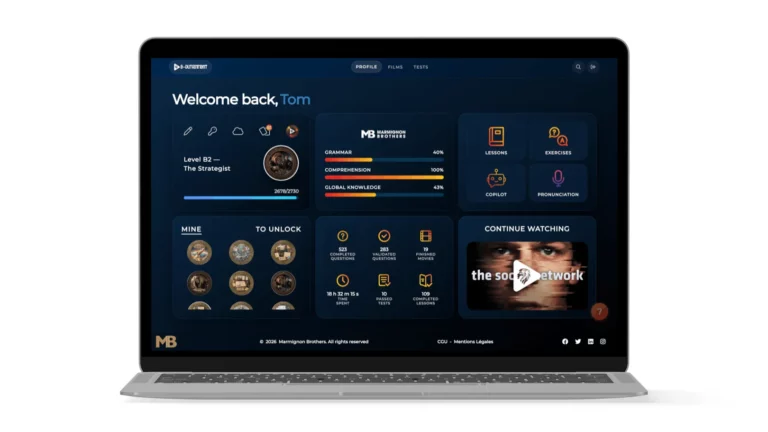
Preparing with the e-dutainment method
Preparing properly means working on the specific skills the test assesses: listening, speaking, reading, writing and professional vocabulary.
The e-dutainment method uses complete films in their original version to build English skills in authentic contexts. In practice, that works well for:
- Improving listening comprehension and command of English in real communication situations
- Building business English vocabulary in professional contexts
- Working on speaking and pronunciation from Hollywood dialogue
- Developing the professional English that is directly useful on the day of a TOEIC or Cambridge test
→ Discover our professional English training and prepare your certification with e-dutainment.
Sources and references
- Teaching source: Learning resources developed by Marmignon Brothers for the e-dutainment app and the English training courses offered by the organisation.