
Watching a film in English can train the ear, but passive viewing alone does not guarantee progress. Learners need guidance: a reason to listen closely, identify meaning, notice an expression and reuse it. Edutainment creates that bridge between attention and action by turning entertainment into a structured language-learning experience.
For English learners, this approach is especially relevant. Films and videos provide authentic voices, emotion and context, while interactive activities help transform exposure into comprehension, vocabulary and confident communication.
What Is Edutainment? Where Education and Entertainment Meet
The term “edutainment” refers to educational content presented through an entertaining and participatory format. It combines education and entertainment around a clear objective: helping people understand, practice or remember something while remaining actively involved.
This is more than putting a quiz after a video. Engaging content, story and interaction must work together. A strong activity presents learning content in an entertaining way, asks the participant to make a decision and then explains the result.
Long before online platforms, productions associated with Walt Disney showed how visual narrative could explain complex concepts. Modern educational technology expands the same principle through interactive video, artificial intelligence, game mechanics and personalized pathways. For a broader introduction to the approach beyond language learning, see our reference article on edutainment in the classroom.
Benefits of Edutainment for Every Language Learner
Language is easier to understand when it appears in a meaningful situation. A film scene shows who is speaking, why the conversation matters and how tone changes the message. These clues help the learner interpret a new language without translating every sentence into their native language.
Context also supports retention. An expression linked to a character, emotion or decision is more memorable than the same expression presented in an isolated list. Short questions and opportunities to reuse the phrase can motivate continued practice and build confidence.
Another benefit is attention. Many digital users have fragmented attention spans, so each activity needs a clear purpose and manageable rhythm. A scene followed by an immediate task can captivate without overwhelming. Well-structured tasks can become fun learning experiences while preserving rigor, and the result is engaging learning that feels relevant rather than repetitive.
Choosing the Right Format for Language Learning
Different formats support different skills:
- Full-length films develop sustained listening, narrative comprehension and familiarity with recurring voices.
- Short videos focus attention on a specific expression, pronunciation point or professional situation.
- A contextual quiz verifies understanding and corrects misunderstandings immediately.
- Flashcards help learners revisit vocabulary and use it in a new sentence.
- Pronunciation activities connect listening with speaking and provide positive reinforcement.
- A role-play simulation develops fluency in meetings, interviews or negotiations.
- A puzzle or interactive animation can introduce grammar and problem-solving in a playful way.
Playing games is not the objective in itself. Games designed for language acquisition must require the learner to understand or produce English. This turns learning through play into purposeful practice and separates game-based learning from entertainment with no pedagogical outcome.
How the e-dutainment Platform Turns Viewing into Practice
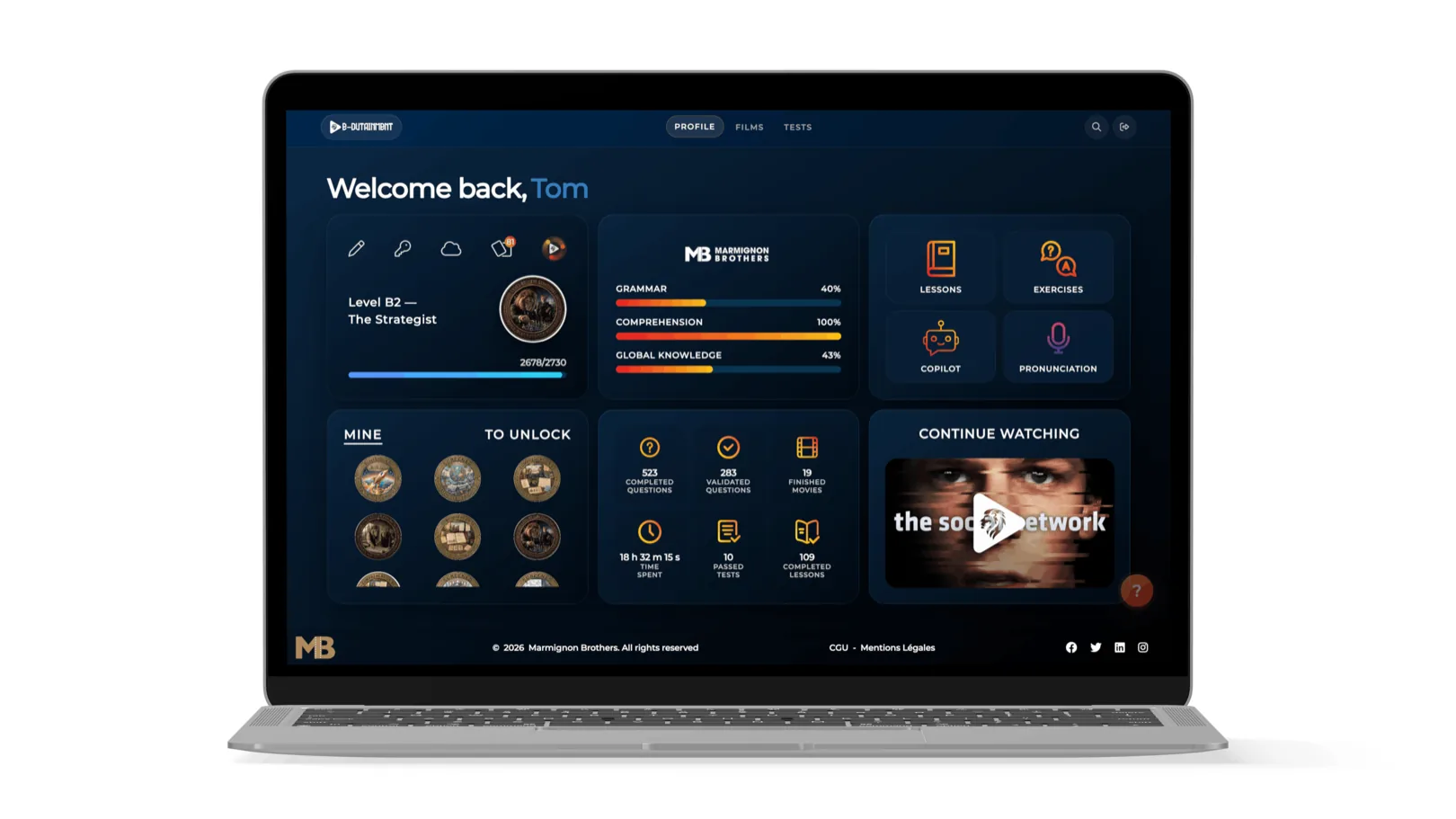
The e-dutainment platform combines full-length films, educational videos and interactive practice within a structured English pathway. Instead of ending when the credits appear, the viewing experience continues through contextual questions, flashcards, pronunciation work and targeted review.
A placement test identifies the starting point, and CEFR-aligned pathways organize activities for different levels. Artificial intelligence can personalize recommendations according to performance, recurring difficulties and interests. This creates personalized learning without removing the role of a teacher or trainer.
Gamification supports continuity through progress markers, challenges and achievements. These elements are used to encourage regular practice, not to replace the learning objectives. Each learner’s activity remains connected to comprehension, vocabulary, grammar or communication.
Developed by Marmignon Brothers, e-dutainment is designed for individuals, schools and companies that want a more contextual and flexible approach to English.
Edutainment and Technology: AI and Interactive Tools
Edutainment and technology are closely connected, but the goal is to use technology to enhance learning rather than create a distraction. Artificial intelligence can recommend relevant material, identify patterns in errors and adapt the next activity. Real-time feedback can help users understand where they are progressing and where more practice is needed.
Virtual reality, or VR, can immerse a participant in an airport, a conference or a business meeting. Augmented reality, or AR, can augment the physical world with vocabulary and instructions. These tools create immersive learning opportunities, although they are only useful when tied to a specific learning goal.
In the digital age, the most impactful systems are not necessarily those with the most features. They are the ones that integrate video, interaction and feedback into a coherent learning strategy.
Immersion: From Listening to Speaking
A contextual approach does not mean leaving a learner alone in front of difficult content. Effective support makes authentic language understandable while preserving its natural rhythm and cultural context.
Subtitles, replay options and focused questions can help users notice key information. Flashcards then reinforce vocabulary, while pronunciation practice encourages them to repeat and reuse the language. This progression allows participants to immerse themselves in English without losing direction.
Over time, the aim is to reduce dependence on translation and develop the ability to think, respond and interact directly in English. The participant moves from recognizing a phrase to using it in a real conversation.
Education with Entertainment in the Classroom and at Work
Education with entertainment can be used in the classroom, during remote learning or inside corporate training. The structure changes according to the audience, but the principle remains consistent: authentic content leads to a guided activity and then to active use.
In early childhood, teachers and parents may use stories and songs to introduce vocabulary. In secondary school or higher education, educational programs can combine video with project-based learning and collaborative analysis. Teachers can teach students to identify intention, compare viewpoints and justify an interpretation.
In corporate training, a scene involving negotiation, leadership or intercultural communication can become the starting point for role-play. Teams analyze the exchange, practice alternative responses and apply the language to their own work. Online learning also makes these training programs accessible to distributed teams and supports continuity between live sessions.
Examples of Edutainment for English Learning
Examples of edutainment can range from a five-minute task to a complete learning sequence:
- Learners watch a film scene without subtitles and identify the relationship between the speakers.
- They replay the scene with English subtitles and select the expressions that reveal tone or intention.
- A short quiz checks comprehension and explains each answer.
- Flashcards reinforce the most useful vocabulary.
- Participants recreate the situation through a role-play adapted to their professional or academic context.
Other learning activities may include an interactive world history video, a branching business scenario or serious games focused on customer communication. These activities are designed to teach language through decisions and consequences rather than through memorization alone.
This approach can also support a participatory project. A group might create a short video, write an alternative ending or present a solution to a case. Such activities make education active and give learners a concrete reason to communicate.
How to Educate Without Losing the Enjoyable Experience
The most effective edutainment techniques begin with learning objectives, not technology. Before selecting a film or interactive tool, the educator should define the specific learning outcome: understand a negotiation, use five new expressions, improve pronunciation or deliver a short presentation.
The activity should then balance challenge and support. Content that is too easy will not stimulate progress; content that is too difficult may discourage the student. Clear instructions, inclusive alternatives and constructive feedback should encourage the student to try again. They also help maintain attention while teaching complex material.
Assessment also needs perspective. Test scores can show progress, but communication is demonstrated through action. Can the participant understand an unfamiliar speaker, respond appropriately and transfer vocabulary to a new context? Those questions matter as much as a numerical result.
Used carefully, edutainment can make learning more human. It offers a fun way to practice without trivializing the subject, creates an enjoyable experience and opens new learning opportunities for people who have disengaged from conventional courses. It respects the fact that people learn through context, repetition, action and feedback.
A More Active Way to Learn English
The value of edutainment lies in the transition from watching to doing. A story captures attention; a question directs it; feedback clarifies meaning; practice turns recognition into ability.
By connecting films, AI, gamification and human support, e-dutainment helps individuals and organizations transform English exposure into regular, measurable practice. Entertainment becomes the starting point, while learning remains the destination.
Sources and references
- Teaching source: Learning resources developed by Marmignon Brothers for the e-dutainment app and the English training courses offered by the organisation.