Cinema works on serious subjects through genre, and the western is one of the clearest examples. In Back to the Future Part III, the western is not just a nostalgic setting. It becomes a working metaphor for freedom and adventure, while the film takes on responsibility, identity and choice.
Ending a science-fiction trilogy in a western is a stranger decision than it looks. The two genres are usually treated as opposites — one facing forward, one backward — and the film’s argument is that they are asking the same question about whether a person can determine their own life.
Back to the frontier
Marty McFly and Doc Brown travel to 1885, into the middle of the American frontier — a period when the pioneer spirit and the search for freedom were at their height.
The western reflects individualism and self-reliance. Its characters face obstacles in order to shape their own fate, and the return to that era brings with it the whole idea of westward expansion and the search for an identity of one’s own, at a distance from modern constraints.
The film is affectionate rather than critical about this mythology, and it is worth knowing that the mythology is exactly that. The frontier of the western is a construction, and the freedom it depicts was available to a much narrower group of people than the genre usually admits.
The search for freedom
The time travel itself stands for that search. Marty wants to free Doc from a fate that has already been written, which is a fairly direct image of the struggle for individual liberty.
The frontier is a place where the rules are open to question, and it embodies the possibility of shaping your own future. The theme lands because the film means it literally: an individual can change the course of their own life. That is the film’s central message and its invitation — take control of your own direction.
Doc’s arc completes it. He arrives believing he has no future and finds a reason to want one, which turns the rescue mission into something more complicated: Marty has come to save a man who has decided he does not need saving.
Adventure and risk
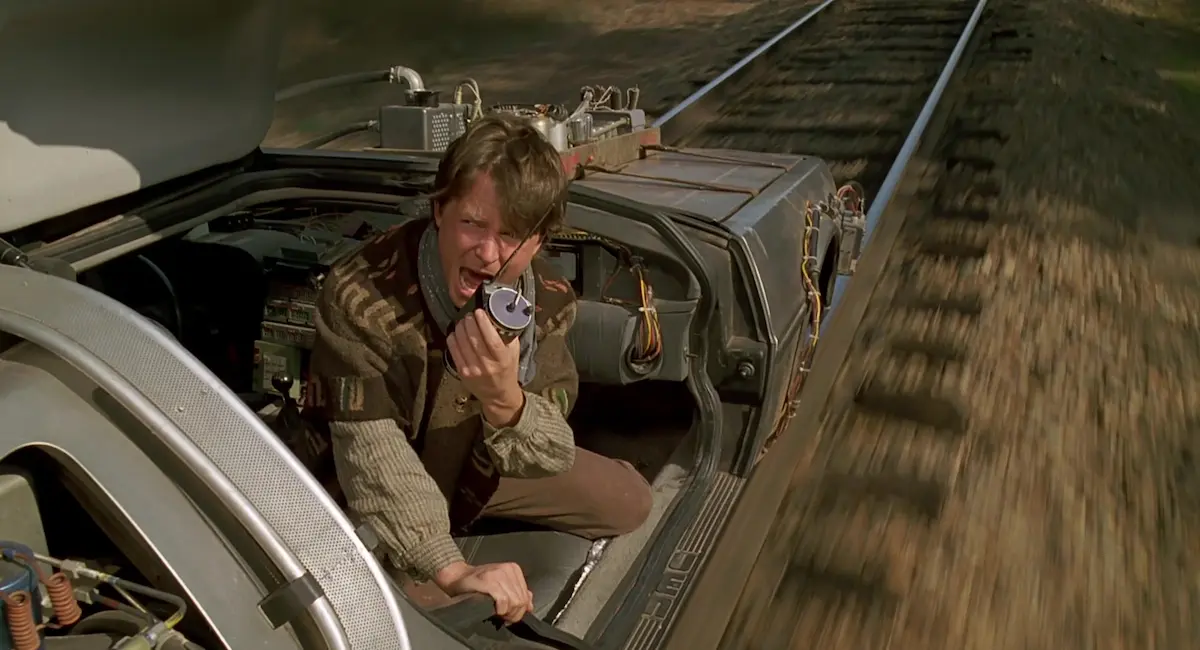
The western also means adventure, and this film commits to it. Marty and Doc face duels, bad luck and confrontations with outlaws, and those elements make the point that reaching an objective requires accepting risk.
Adventure is not only a feature of the frontier; it is a part of life. Every choice can lead somewhere unexpected, and the film treats that as a reason to make choices rather than avoid them.
The trilogy’s running theme lands here. Marty’s inability to refuse a challenge has been his weakness across three films, and the western — a genre entirely built on men who cannot walk away from a confrontation — is the right place to resolve it. He finally declines, and that refusal is the whole character arc.
Identity and roots
Returning to the past confronts Marty with questions about where he comes from. The frontier is a period where traditional values are being tested and characters have to navigate between their past and their future.
Meeting his own ancestors makes the film’s argument visible: our roots shape who we are. That exploration is central to the western as a genre, where characters usually have to fight for a place in a world that is changing under them.
Meeting the Irish McFlys also does something quietly funny and quietly serious: Marty discovers that the family traits he assumed were personal have been running for a century. Identity is inherited and chosen at once, which is more or less the trilogy’s position on everything.
A tribute to the genre
By integrating classic western elements — the costumes, the landscapes, the cadence of the dialogue — the film honours a genre that held audiences for decades, while adding something contemporary to it.
That fusion produces a genuinely unusual experience: the viewer is transported into the past and confronted with the timeless material of freedom and adventure at the same time.
The references are specific rather than general — the Monument Valley landscapes, the clock-tower confrontation, the town names — and the film assumes an audience who will recognise them. That is a compliment to the viewer that few blockbusters pay.
Back to the Future Part III goes past entertainment by making the western carry a real argument, and it ends by suggesting that adventure and freedom are essential to a life — and that the path is yours to make.
Three scenes worth rewatching
The arrival in Monument Valley. A DeLorean in a John Ford landscape. The whole premise of the film, established in one shot.
The saloon. Marty attempting to use 1980s social rules in 1885. Comedy doing the work of exposition.
The refusal. The moment Marty walks away from a fight. Three films of setup, resolved without a line of explanation.
Language notes
Two distinct registers: 1950s and 1980s American, and stylised nineteenth-century western speech. A rewarding contrast at upper-intermediate level.
The western dialogue is a genre convention rather than historical reconstruction — nobody spoke that way — but it is a consistent, learnable register with its own vocabulary and rhythm, and recognising it is genuinely useful for anyone who reads or watches American fiction. The film also uses the contrast deliberately, so you hear Marty’s modern speech sound wrong in context.
Expressions worth collecting:
- «Yellow» — cowardly; the period version of the insult Marty cannot ignore
- «Reckon» — to think or suppose; a marker of western and rural American speech
- «Ride off into the sunset» — to leave at the end of a story; now an idiom for any tidy conclusion
- «Your future is whatever you make it» — the trilogy’s closing line, and its entire argument