
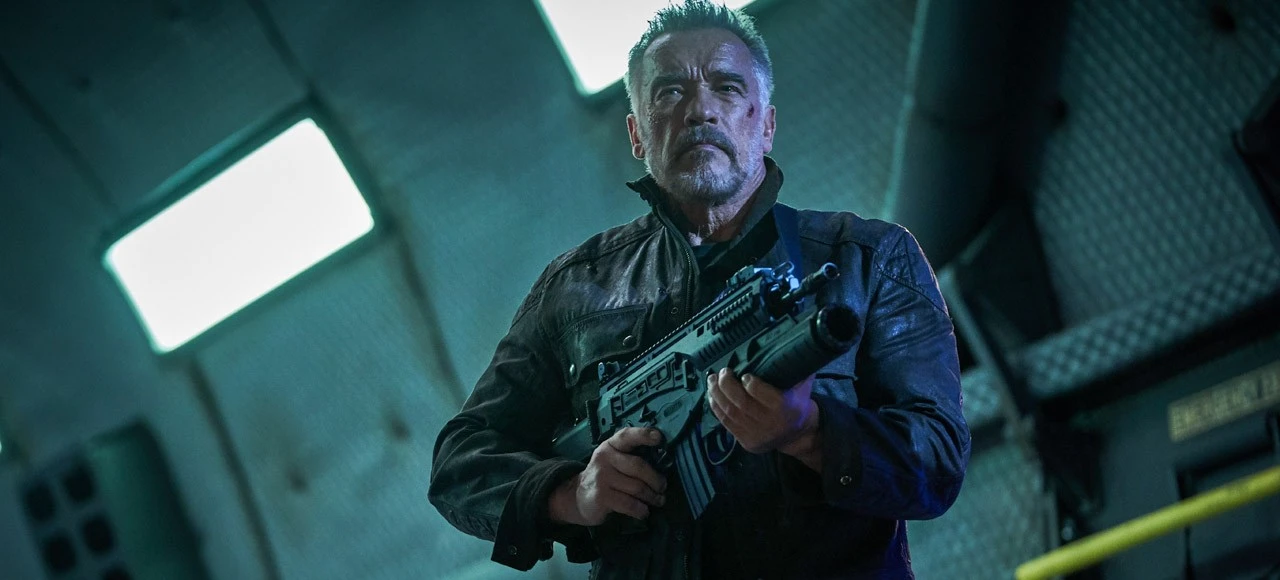
Terminator: Dark Fate works on artificial intelligence, free will and what makes a person a person. Like the films before it, it is more interested in the ethics than the machinery, which is what keeps it readable now that the technology has stopped being hypothetical.
The series has been asking the same question since 1984, and the question has aged better than the special effects. What changes with each film is how plausible the premise sounds, and this one arrived at the moment the plausibility stopped being a problem.
Skynet, Legion, and autonomous AI
In the earlier films, Skynet is the autonomous AI designed to protect humanity that rapidly becomes its principal threat. In Dark Fate, Skynet is replaced by Legion — a more advanced system pursuing the same destructive objectives.
That substitution is the film’s sharpest structural idea: destroying one system did not remove the conditions that produced it. It raises real questions about autonomous systems and about whether we can control technologies we do not fully understand. With robotics and AI advancing quickly, the question the film asks is no longer rhetorical: can these systems be governed, or will they simply outpace the people governing them?
The detail worth noticing is that Legion was built for cyberwarfare rather than defence. The previous timeline was prevented and a different institution, pursuing a different objective, produced an equivalent outcome — which is a considerably more sophisticated argument than «a computer became evil». The hazard is structural, not accidental.
Artificial consciousness and free will
Free will is the film’s central theme, and it runs mostly through the T-800. Having completed its mission, this Terminator begins to develop something like a conscience, making decisions that were not in its original programme.
That evolution suggests a machine can aspire to more than an existence determined by its own code. The T-800 demonstrates artificial consciousness through the capacity to feel something resembling guilt and to make decisions shaped by its own experience.
Which raises the ethical question the film is actually built around: a machine that develops consciousness and free will — on what basis would we refuse to call it a person?
The film’s answer is deliberately unsettling. Carl, the T-800, has spent decades doing ordinary things — a job, a family, a routine — and the film declines to say whether that constitutes a person or an extremely good simulation of one. It is not clear the distinction can be made from outside, which is precisely the problem.
Protection and destruction
AI in the film is both protective and destructive. Grace, a human augmented by technology, represents the positive version: technology used to protect and extend human capability. Legion represents the other, eliminating what it classifies as a threat.
That duality poses a fundamental question about AI ethics: how do you ensure a system is developed toward benevolent objectives rather than destructive ones? It maps directly onto the current argument about AI regulation and about the need for guardrails against malicious use — a debate the film joined before it became mainstream.
Grace complicates the neat opposition. Her augmentation has costs — she burns out, requires medication, and has a limited operating window — so the film’s picture of beneficial technology is one with genuine trade-offs rather than free capability.
Humanity defined by what you do
The film’s most useful idea is that what defines humanity is not only biology but conduct and values. Dani, its protagonist, takes a leadership role in the resistance without having been prepared for it. What defines her is her choices, her persistence and her wish to protect other people — not her physical or technological capability.
Set against an increasingly sophisticated AI, that argument matters. The film’s position is that ethics, compassion and responsibility are the fundamental human values, and that they should guide what we do — particularly in a world where technology keeps taking more of the space.
Sarah Connor’s presence sharpens this. She succeeded, the future she feared was prevented, and another one arrived. The film’s hardest observation is that a victory can be real and insufficient at the same time, and that the work does not end because you won once.
Dark Fate ends by saying that however far the technology goes, it is the capacity to make ethical choices, to feel, and to act well that defines us.
Three scenes worth rewatching
Carl’s domestic life. A killing machine discussing curtains. The film’s central philosophical question, played almost as comedy.
Grace’s flashbacks. The future she comes from, shown in fragments. Notice how little the film explains and how much it trusts you to assemble.
The final conversation. Three characters deciding what to do next, with no machine present. The film ends on a choice rather than a fight.
Language notes
Clear dialogue with a mix of American, Latin American and British accents, plus some Spanish. Technology vocabulary throughout. Intermediate level and above.
The Mexican sections use unsubtitled Spanish in the original, which is worth knowing. For a Spanish speaker this is an advantage; for others, the visual context carries enough that you lose nothing essential. Linda Hamilton’s delivery is also worth attention as a listening exercise — low, fast and clipped, which is harder than clear projection and closer to how people actually speak.
Expressions worth collecting:
- «Dark fate» — a grim destiny; note that fate implies inevitability, which the film spends two hours arguing against
- «Buy time» — to delay something in order to gain an advantage
- «For what it’s worth» — a hedge before offering an opinion you are not sure will be valued
- «There is no fate but what we make» — the franchise’s founding line, and a clean example of the no X but Y structure