
English training is one of the easiest development budgets to justify and one of the hardest to spend well. The market is crowded, prices vary by a factor of ten for outwardly similar programmes, and the thing that determines the return — whether people actually end up able to work in English — is not visible in a quote. This guide covers how to fund and structure English training for a team, and what to check before committing.
Start with the business case, not the budget
The question is not «how much does English training cost» but «what does it cost us not to have it». That usually resolves into something specific:
- Meetings with international clients or partners that run at a disadvantage
- Written communication that has to be reviewed by someone else before it goes out
- Roles that cannot be filled internally because the language requirement excludes strong candidates
- Documentation, tooling and technical material that a proportion of the team cannot use directly
Naming the specific friction gives you both a budget justification and, more usefully, the objective the training should be built around. «Improve everyone’s English» produces no measurable outcome; «enable the sales team to run a client meeting unaided» does.
Budgeting per learner, not per programme
The useful unit is cost per learner per level gained. Moving someone from B1 to B2 on the CEFR scale typically takes 150 to 200 hours of genuine practice; from B2 to C1, considerably more. Any provider quoting a level jump in twenty hours is quoting something else.
That arithmetic is what makes the format decision. A large budget spread thinly across an entire workforce produces exposure without progression. A smaller budget concentrated on the people whose roles actually require English produces measurable movement.
Group or one-to-one
One-to-one is the fastest route for a specific individual with a specific objective — a person taking on an international role, or someone who needs to reach a certification threshold. It costs more per hour and less per level gained.
Group training works when participants are genuinely at the same level and share a context. It fails when a group is assembled by department rather than by level, which is the most common way corporate language training goes wrong.
A blended approach — self-paced work between live sessions — is usually the best value, provided the self-paced part is something people will actually do. This is where content matters more than platform features.
What to check before you commit
Placement testing. Any serious provider tests before proposing. A quote issued without knowing the starting levels is a quote for a product, not a programme.
The certification, if there is one. If the objective includes a certification, check which one, that it matches the target level, and that the preparation is built around what the test actually assesses. TOEIC, TOEFL, Cambridge and Linguaskill are not interchangeable.
Trainer profile. «Native speaker» is not a qualification. What matters is training in language teaching and experience with the professional context your teams work in.
Reporting. You should be able to see attendance, progression against the CEFR scale, and what each learner is actually working on. Without that, you find out whether the money worked at the end rather than during.
Scheduling realism. Training scheduled on top of a full workload is training that gets cancelled. Agreeing protected time with managers before the programme starts is the single change that most improves completion rates.
Making the spend stick
The most common failure is not choosing the wrong provider — it is stopping too early. Language progress is slow and non-linear, and a programme cut at the point where the learner has just become able to follow a meeting will feel like a failure and be recorded as one.
Three things protect against that:
- Measure at the start. A placement test at week one is what makes any later claim about progress credible.
- Build practice into the work. A recurring meeting held in English, or documentation written in English, does more than an extra hour of class.
- Plan for a year, not a term. Budget accordingly, and review at intervals rather than at the end.
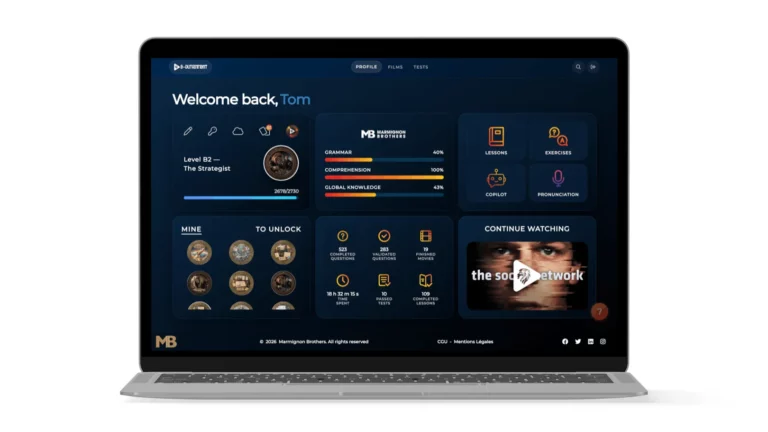
Training with e-dutainment
e-dutainment courses are delivered by Marmignon Brothers, a training organisation certified to the French Qualiopi quality standard, and are available internationally by distance learning.
The method uses complete films in their original version, which addresses the specific problem most corporate English training has: learners who can pass an exercise and freeze in a real conversation. Working from authentic dialogue — real accents, real pace, real idiom — builds the listening capacity that classroom material does not.
Each pathway is built around the starting level and the professional objective, whether that is business English, certification preparation, or general English for a team that needs to operate internationally.
→ Discuss a training plan for your teams.
Sources and references
- Teaching source: Learning resources developed by Marmignon Brothers for the e-dutainment app and the English training courses offered by the organisation.