
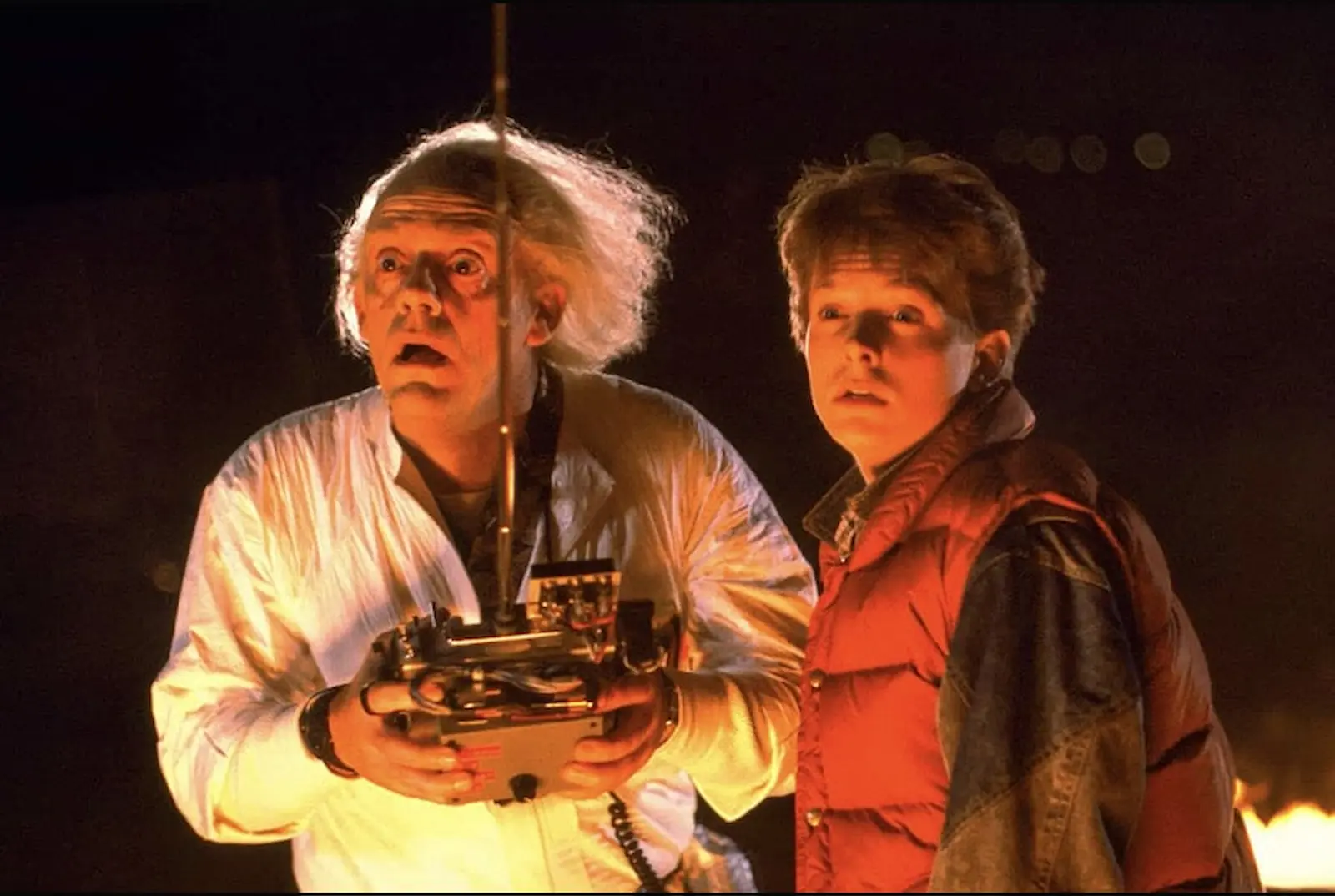
Almost everyone has, at some point, wanted to travel in time — to see the past, glimpse the future, or quietly correct one decision. Back to the Future is built entirely on that wish, and it handles time in a deliberately unstable way.
A short philosophical detour
One of the first ideas encountered in a philosophy class is that the present barely exists: we move from past to future, and the present is only the join between them. The moment you name it, it has already become the past.
The present, on that view, speaks for both memory and anticipation. It is where the past turns into the future. And the past itself is not fixed either — it is a reinterpretation of our own memories, so we could never restore it exactly as it was, even if we could go back.
There is also a useful distinction between objective time, the shared time of clocks and calendars, and subjective time, the time each consciousness actually experiences. The two rarely agree. Someone facing the end of their life wants more of it; someone in pain wants less. People are almost never satisfied with the amount of time they have, which is why we imagine it differently — the imagined time of the title.
The film literalises this. The DeLorean makes subjective time — the time you wish you had, or wish you could revisit — into something you can drive. That is why the premise is satisfying in a way that a straightforward adventure would not be: it grants the wish everyone has already had.
A concept that trips you up on purpose
If you do not know the film, the title suggests it takes place in the future. It does not. It takes place in the past, and the future Marty is trying to return to is simply his own present.
There is a small pleasure in noticing that this article is itself written in the film’s future — it was released in 1985 — and a larger one in noticing that a film about time travel has itself travelled through time. It has stayed culturally present for four decades without being displaced.
Robert Zemeckis and Bob Gale reportedly had the script rejected more than forty times before it was made. Studios found it too tame for the studios that wanted raunchy comedy and too odd for everyone else. That is worth knowing: the film that defined a decade’s idea of itself was, for years, the one nobody wanted.
Does Marty rescue the past?
Marty is sent accidentally from 1985 back to 1955, where he meets his own parents and his mother falls in love with him. To exist at all in 1985, he has to redirect that love toward his father.
But that is not all he does. His father is being bullied by Biff; his mother is drinking in a way that points toward the version of her Marty knows. So Marty teaches his father to stand up to Biff and works on his mother’s drinking.
By the end he has genuinely rescued his own past: he returns to a 1985 where his parents are happier than the ones he left.
Notice what the film says about how that happened. Marty does not give his father money, contacts or opportunities. He gives him a single moment of standing up for himself, and everything else follows from the change in how George sees himself. The film’s argument about transformation is that it starts internally and that external circumstances reorganise around it — which is either inspiring or simplistic depending on the day you watch it.
Imagined time, and why it appeals
Time travel fascinates artists precisely because it stays impossible. Memory colours the past unreliably; elapsed time cannot be altered. The future looks more editable, but remains tied to circumstance in ways we do not control.
Back to the Future lets Marty do what most people would quietly like to do: change one thing back there and improve everything here. It remains a fiction — an imagined version of time — and that is exactly why it is still enjoyable to fall into.
There is a darker reading available, and the sequel takes it up. If one small change can improve a life, one small change can also ruin it. The photograph in Marty’s pocket, with his siblings gradually disappearing, is the film’s reminder that the fantasy cuts both ways.
Three scenes worth rewatching
The Twin Pines Mall. Watch the sign at the start and at the end. The film tells you its entire thesis about consequences through a piece of set dressing, without a line of dialogue.
The dinner table in 1955. Marty meeting his mother as a teenager is played for comedy and is doing something serious: it makes the point that our parents were people before they were parents.
The lightning strike. A sequence built entirely on timing, where every element has been established beforehand. It is one of the cleanest examples in popular cinema of setup and payoff.
Language notes
The dialogue is fast, comic and full of period American slang across two eras — 1985 and 1955 — which is part of the fun and part of the difficulty. Excellent for upper-intermediate learners; use English subtitles the first time.
The film is deliberate about generational slang, and this is unusually useful for a learner: you get to hear which expressions date and which survive. Marty’s 1985 vocabulary confuses people in 1955, and the film makes a running joke of it.
Expressions worth collecting:
- «Heavy» — 1980s slang for «serious» or «significant»; Doc keeps misunderstanding it literally, which is the joke
- «Make like a tree and leave» — Biff’s mangled idiom; the correct form is «make like a tree and leaf/leave», meaning «go away»
- «Give me a break» — stop bothering me, or I do not believe you; extremely common in spoken American English
- «Where we’re going, we don’t need roads» — the closing line, and a good example of the where + clause fronting structure used for emphasis