Back to the Future Part II is a time-travel film, and it is also an unusually complete record of what the 1980s hoped for and worried about. Its imagined future says more about the decade that produced it than about any decade since.
The film’s 2015 is now in our past, which gives it a second life it was never designed for. Watching it today is a double exercise: seeing what the 1980s expected, and measuring the distance between that and what arrived.
Technology and the aspirations of the decade
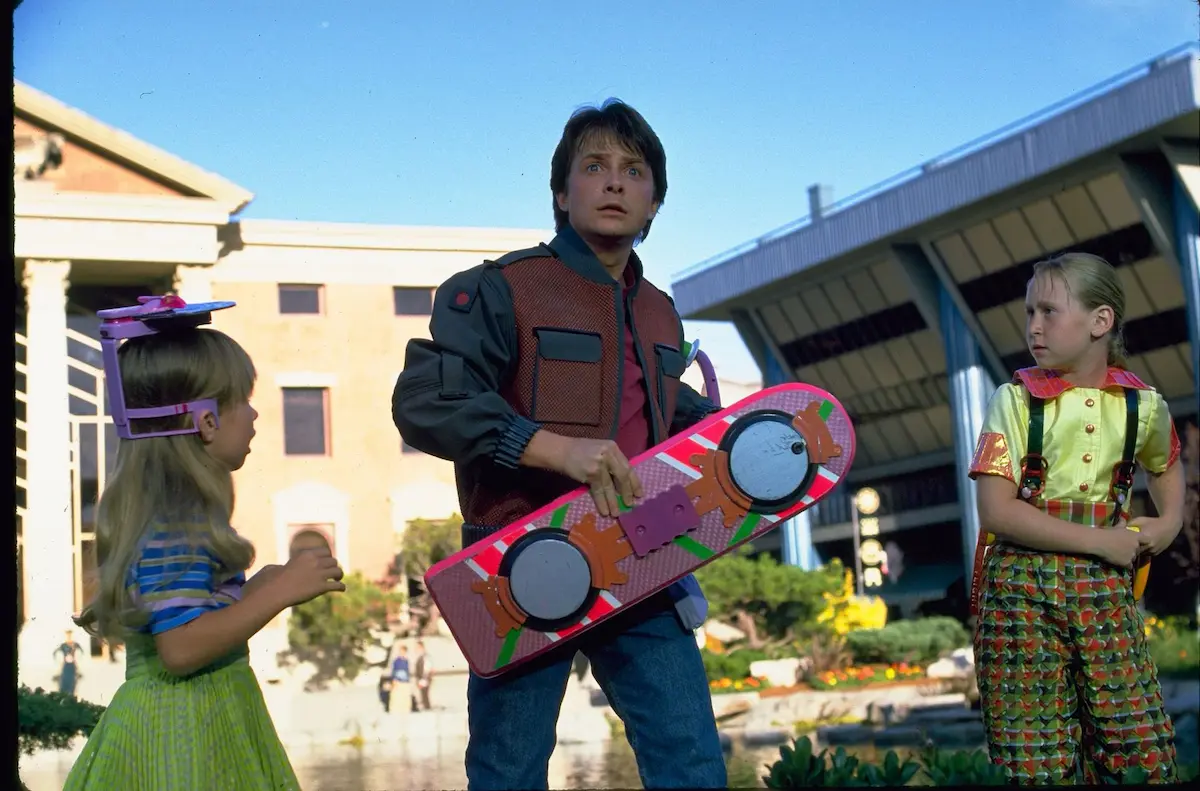
The hoverboards and flying cars are the most memorable things in it, and they stand for the era’s appetite for freedom and innovation. The film reflects a genuine fascination with what technology was about to deliver, and with the idea that mobility might become unlimited.
The 1980s produced the personal computer and the video game industry, and the enthusiasm in the film is not invented: technology was widely read as the engine of both progress and personal freedom, with very little scepticism attached.
What the film got wrong is instructive. It imagined transformed physical objects — flying cars, self-drying jackets, fax machines in every room — and entirely missed the network. The actual revolution was informational rather than mechanical, which almost nobody in 1989 anticipated.
The family as the centre of society
Family occupies the structural centre of the film. The complicated relationship between Marty McFly and his parents, and the interactions within the McFly household, reflect the dominant family values of the period, when the family was routinely described as the foundation of society.
The film’s mechanism reinforces this: individual actions upset the family equilibrium, and the plot depends on responsibility inside the household. That is a fair snapshot of how much weight the decade placed on family unity.
The 2015 sequence goes further, showing a McFly family that has quietly failed. Marty’s own weakness — an inability to refuse a dare — has produced a diminished adult life, and the film treats character as the thing that determines a family’s fate. That is a very 1980s proposition, and worth noticing as a proposition rather than a fact.
Gender roles, and the first signs of change
The gender roles are typical of the 1980s. Female characters are largely secondary, while Marty and Doc Brown hold the centre.
There are hints of a shift, though. Jennifer, even in a supporting role, shows initiative and curiosity of her own. Those small signals point toward the changes in women’s position in society that the following decades would make explicit — which is what makes the film readable as a document rather than only as entertainment.
The alternate 1985 makes an interesting counter-case. Lorraine in that timeline is trapped in circumstances she cannot escape, and the film treats her lack of options as horrifying — which suggests the decade was more conscious of the constraint than its ordinary storytelling admitted.
Fashion, projected forward
The self-adjusting jackets and self-lacing shoes are 1980s fashion imagined into the future. They stand for the era’s expansive imagination and its assumption that the future would above all be more comfortable.
The film captures the decade’s aesthetic accurately — bright colours, bold shapes, and a pronounced taste for spectacle — and then transposes it forward, which is why its version of the future looks so specifically like 1989.
Every era’s imagined future does this. The clothing in the film is not a prediction; it is the 1980s wearing more of itself, which is what a projected future always turns out to be.
Time and the consequences of what we do
Marty and Doc travel into the future to prevent bad things from happening, and that idea landed particularly well in a decade shaped by Cold War tension and economic anxiety.
The film invites reflection on the weight of individual decisions and on how they affect other people’s lives as well as our own. That theme has not aged, and it is a good demonstration of cinema working as a tool for thinking about a society rather than escaping it.
The alternate 1985 is the darkest thing the trilogy does. A single object in the wrong hands produces a wrecked town, and the film lingers on it long enough to make the point that the mechanism which allowed Marty to improve his family also allows everything to be destroyed.
Revisiting the film is a way of understanding what the 1980s valued and feared — and an invitation to ask what our own picture of the future says about us.
Three scenes worth rewatching
The Cafe 80s. A 2015 that is nostalgic for the 1980s. The film predicted the retro industry with more accuracy than it predicted the technology.
Biff’s tower. The alternate timeline, shot like a different film entirely. Notice how the colour palette changes.
The overlap with the first film. The final act returns to scenes you have already watched, from new angles. It is a genuinely difficult piece of construction.
Language notes
Fast comic American dialogue with a lot of period slang across three different time settings. Upper-intermediate; watch the first film before this one.
The film’s use of dated slang is a good lesson in how quickly informal English moves. The 2015 characters use invented future slang that now sounds absurd, while the 1955 and 1985 vocabulary is real and datable — a useful reminder that idiom is the fastest-changing layer of any language.
Expressions worth collecting:
- «Chicken» — used as an insult meaning coward; Marty’s trigger throughout the trilogy
- «What’s the deal?» — what is going on, or what is the problem
- «Set things right» — to correct a situation that has gone wrong
- «Butthead» — a mild period insult; useful mainly for recognising how dated slang sounds