There are plenty of reasons to watch 8 Mile. Here are three that hold up — and one warning about the English, which is some of the fastest in mainstream cinema.
1. It is a well-made biopic
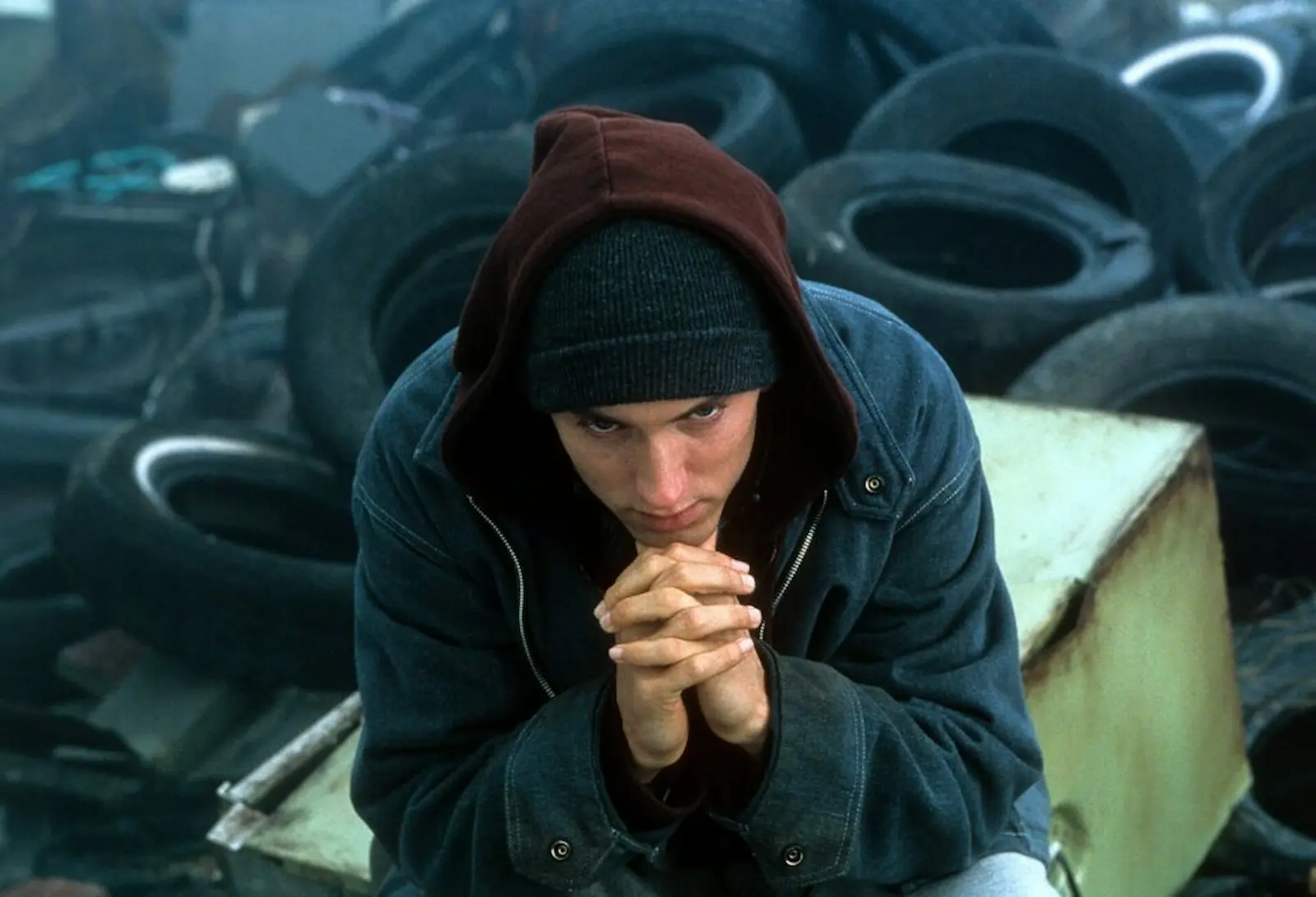
The film knows exactly what it is doing with colour. The grey of Detroit carries the weight of Jimmy’s life; the green of the bathroom where he rehearses before battles marks the space where the internal fight happens. The same imagery reappears in the video for Lose Yourself, which reuses footage from the film — so the song and the film are visually continuous, not merely associated.
Curtis Hanson, who directed it, had made L.A. Confidential five years earlier, and the craft shows. This is not a vanity project built around a musician; it is a proper film that happens to star one.
The performances hold. Eminem is not a professional actor, and it does not matter: he sustains the emotional register the film needs, largely by underplaying. Kim Basinger, as his mother, does something harder — she makes a character who could easily have been a caricature into someone recognisable.
One detail worth knowing: in the bus scene, Jimmy writes lyrics in a notebook. Those are the actual lyrics of Lose Yourself, written during the shoot. The song and the film are about the same thing, which is why the connection between image and music is so tight.
2. It is genuinely motivating
The central message is not subtle, and it does not need to be: turn what hurt you into work.
Beyond the financial ambition the film also depicts, what is interesting is the artistic impulse — art as a way of processing something rather than escaping it. Eminem writes his pain as rap and makes something people want to hear. Whether the pain is resolved is a separate question; what matters is that it is used.
Living from it is hard, and the film does not pretend otherwise. The factory job does not disappear. The housing situation does not resolve. What it shows is someone with talent and persistence who kept going from a starting point with nothing. The consolation is not «you will be famous», it is «your scale does not matter; the motivation and self-belief do».
The ending is the proof of the film’s seriousness. Jimmy wins the battle and then walks back to his shift. A less honest film would have cut to a record deal.
3. The themes go well beyond the music
The friendship between Jimmy and Future is one of the more convincing in the cinema of its decade — a relationship in which one person believes in the other more than he believes in himself, and has to keep doing so without receiving much back.
There is the relationship with Alex, and above all Jimmy’s protectiveness toward his little sister, which runs quietly through the whole film and is never made into a speech.
And there is the writing. We watch him write on the bus and hear those same words come back as rap in the battles. The music is the visible subject; the writing is the one underneath. That is the film’s real argument about creative work: the performance is the part people see, and the notebook is where the work happens.
What the battles actually demonstrate
The final battle is worth analysing as rhetoric, not just as music. Jimmy wins by naming every weakness his opponent could have used against him — his poverty, his trailer, his mother, his failure — before the opponent can. He removes the ammunition, then hands over the microphone.
That is a real technique with a name outside rap: pre-emptive concession, and it works in negotiation and public speaking for exactly the same reason. Anyone preparing a difficult presentation could learn more from three minutes of that scene than from a chapter on handling objections.
Language notes
A warning: the rap battles are fast and heavily idiomatic, with dense Detroit slang and wordplay that depends on double meanings. Advanced learners will get a lot from them. If you are earlier in your journey, start with English subtitles — the dialogue scenes between the battles are considerably more accessible, and the film is worth watching for those alone.
A good method with this film is two passes: first with subtitles for the story, then without, focusing only on the non-battle scenes. Trying to follow a rap battle unaided at intermediate level is discouraging and teaches you very little.
Expressions worth collecting:
- «Lose yourself» — to become completely absorbed in something; the film’s title phrase and its whole thesis
- «Snap out of it» — to recover suddenly from a daze or a bad mood, said to someone else
- «Beef» — a grievance or ongoing conflict between people; very common in informal American English
- «Come up» — used as a noun, someone’s rise from a difficult starting point («his come-up»)