
Unbroken is a war film, but it is first the true story of an Olympic athlete. Louie Zamperini’s life is one of the clearest illustrations of what people mean by mental strength — and of how vague that phrase usually is.
Angelina Jolie directed it from Laura Hillenbrand’s book, and the structure is deliberate: the film gives you the athletics before the ordeal, so that when the ordeal arrives you already know where the capacity came from.
What mental strength means here
It is the capacity to hold on when conditions are against you: to face obstacles rather than avoid them, and to take something from having faced them. That is deliberately broad, because it depends entirely on a person’s history and on what they have already survived.
This is the film’s most useful idea, and it runs against the common assumption. Mental strength is not a fixed quantity distributed at birth. It is closer to a compound: each thing you get through raises the threshold of what feels survivable next time.
First, the athletics
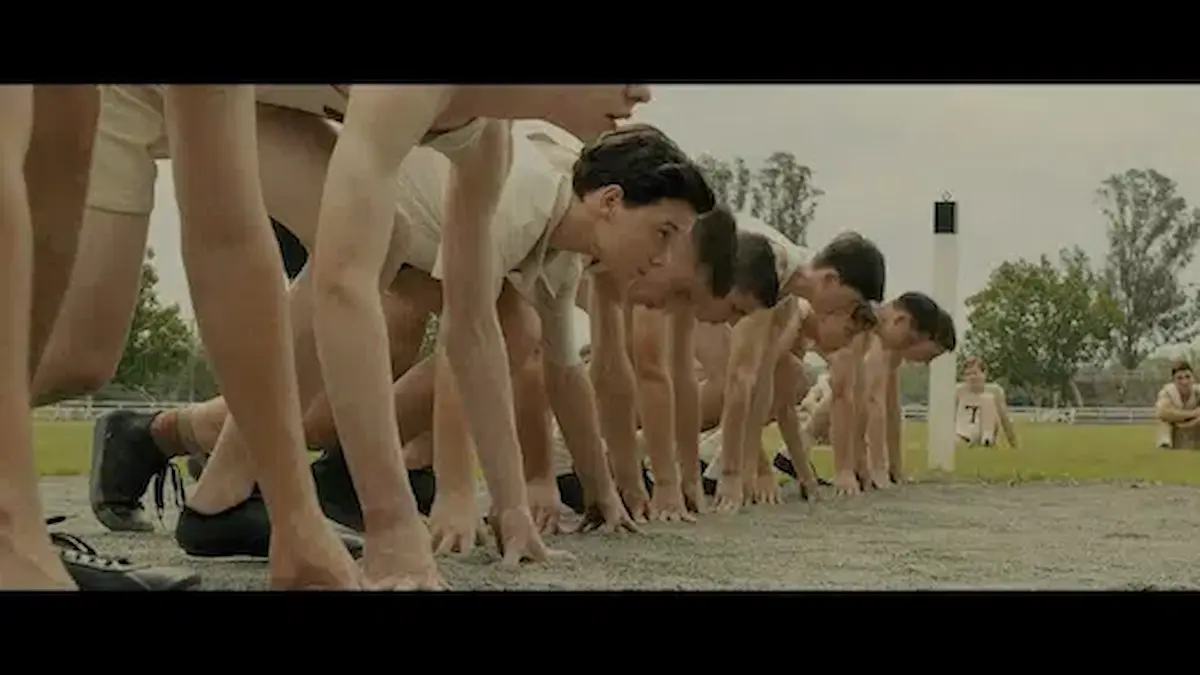
As a child, Louie was trouble. After one prank too many he ran, and his brother, watching him run, understood what he was capable of.
What followed did two things at once. Running appears to have built his mental strength, and his mental strength let him commit to athletics. The two reinforce each other, and together they pulled him off a path that was going somewhere else. He stopped disappointing his family and himself, and ended up competing at the Berlin Olympics.
The detail worth holding on to is that nobody handed him the discipline. It came from a physical practice with immediate, measurable feedback — which is why athletics recurs so often in accounts of resilience. You cannot argue with a stopwatch, and learning to accept that transfers.
Forty-seven days adrift
Louie and two companions spend forty-seven days on a raft. Survival depends on food and water, but above all on wanting to continue. When that wanting goes, the rest collapses quickly.
What the film shows well is how they maintain it. They describe Louie’s mother’s Italian cooking in detail, dish by dish, day after day — an act of deliberate mental construction, not nostalgia. They use humour: Mac attacking a shark, Phil joking about the Japanese aircraft strafing them. During a storm, they pray.
These are not decorative details. They are three distinct techniques — projection into a desirable future, defusing through humour, and appeal to something larger — and all three appear in the accounts of people who have survived extended ordeals.
Mac dies. Phil and Louie survive. The film does not attempt to explain the difference, and that is to its credit. A story that assigned survival to superior character would be both false and cruel.
The prison camp
Captured, Louie faces a guard, Watanabe, who makes breaking him a personal project. The examples accumulate:
- An officer beats him; he gets up.
- He is ordered to run; he falls, gets up, falls again.
- He is told his mother has been informed of his death; he does not react as intended.
- He is offered better conditions for making Japanese propaganda broadcasts; he refuses and returns to the camp.
- Faced with a collective punishment, he asks to take the blows himself.
The refusal of the radio broadcast is the pivot. It is the only moment where he has a genuine choice and a real incentive, and he chooses the worse conditions. Everything before it is endurance; that is decision.
The closing image is the beam: Louie holding it above his head under threat of death, for longer than anyone expects. He shouts, and the shout is the point — strength and rage released at the same time.
Why it matters outside a prison camp
Jolie has said she wanted to show what the human mind is capable of. The useful conclusion is smaller and more practical: mental strength is not a fixed quantity you either have or do not. It is built, largely by having already got through something, and it is worth not underestimating your own.
The corollary is worth stating. If resilience is compounded from previous difficulty, then avoiding all difficulty is not a neutral choice — it leaves the account empty. That is an argument for taking on hard things while the stakes are low, which is roughly what Louie’s brother was doing when he put him on a running track.
Language notes
Dialogue is clear and the pacing leaves room. A good choice for intermediate learners, and one of the more comfortable war films for listening practice because so much of the tension is carried visually rather than verbally.
The Japanese-language sections are subtitled in the original, so you are not losing content by watching in English.
Expressions worth collecting:
- «If you can take it, you can make it» — the film’s repeated line: endurance as the precondition for success
- «Hold on» — literally to grip, but idiomatically to endure or to wait; both senses are in play throughout
- «Give in» — to surrender or stop resisting, distinct from «give up», which means to abandon entirely
- «A moment of pain is worth a lifetime of glory» — his brother’s line, and a clean example of the X is worth Y comparison structure