
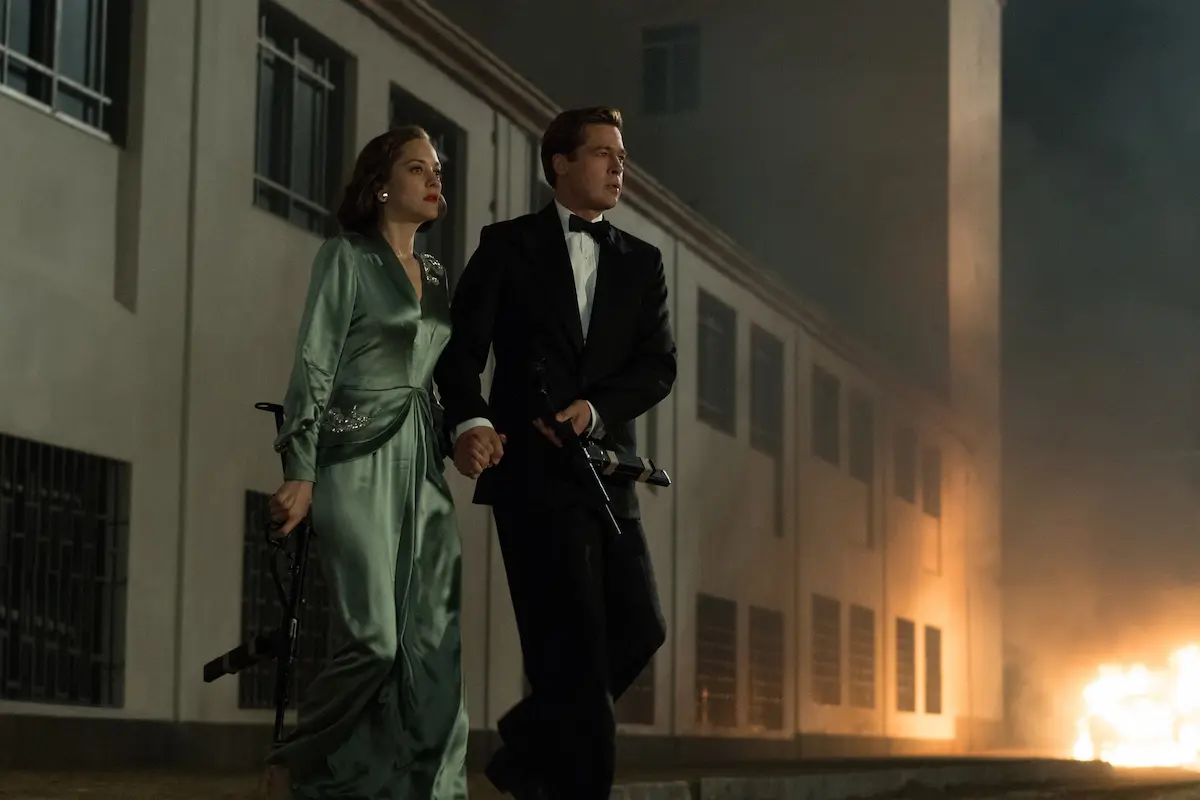
In Allied, Max Vatan (Brad Pitt) and Marianne Beauséjour (Marion Cotillard) are two spies in the Second World War, working in a setting where trust is both essential and nearly impossible. They share a mission and a relationship, and they operate in a world of suspicion and double meaning where a gesture, a look or a silence can carry more than a sentence.
A universal language
Non-verbal communication covers everything conveyed without words: facial expression, gesture, posture, gaze, and silence. It reads across cultures, and it is often more sincere than speech — particularly when speech is being measured or concealed, which for a spy is permanent.
Max and Marianne must control what they say to fit their cover, so the non-verbal channel becomes the one where trust is actually built. Eye contact or a change of posture can signal protection, warning, or shared understanding without anything being admitted aloud.
The premise makes the film an unusually clean laboratory. Because both characters are professionally trained to lie with words, everything meaningful has to travel through another channel — and the audience learns to read that channel alongside them.
What to take into working life
Facial expression builds credibility. A direct gaze and a relaxed face read as confidence and openness. In a meeting, a well-placed smile or visible attention does more for your standing than an extra argument.
Posture and gesture signal reliability. Marianne’s posture — upright, stable — projects a steadiness that others respond to. An open posture reads as transparency; gestures congruent with your words read as sincerity.
Micro-expressions reveal what is actually felt. Emotions leave brief traces on the face even when they are being suppressed. Reading them lets you anticipate a reaction and adjust your response with some empathy rather than pressing on.
A caution on that last one. Micro-expression reading is far less reliable than popular accounts suggest, and treating a flicker as proof of deception is how people talk themselves into misjudging colleagues. Use it as a prompt to ask a better question, never as a verdict.
Under pressure
The film is also a study in managing emotion at high stakes. Max and Marianne handle fear, uncertainty and potential betrayal while keeping a neutral surface. The same discipline applies in a difficult professional moment:
- Visible calm. Relaxed posture, steady breathing, controlled gestures — these reassure the other person and take heat out of the exchange.
- Congruence. A reassuring message delivered with tense gestures produces dissonance, and the other person will trust the gestures.
Congruence is the one worth prioritising. Most people are poor at reading individual signals and very good at detecting mismatch. You do not need to control your body language perfectly; you need to avoid contradicting yourself.
Silence
The silences between Max and Marianne carry more than their conversations. The pauses let each of them read the other without disclosing anything.
At work, silence can be used deliberately: to listen properly, to think, or to leave space for someone to say the thing they were not going to say. In a complicated exchange, a well-placed pause does more than a rehearsed answer.
This is the most underused technique in professional communication. In a negotiation, the person who tolerates silence longest usually receives more information than they give — not through manipulation, but because most people fill a gap without deciding to.
Three scenes worth rewatching
The Casablanca party. Two people performing a marriage in front of an audience that would kill them for a slip. Every gesture is deliberate; watch it as choreography.
The rooftop. A conversation where almost nothing is stated and everything is understood. The gap between the words and the meaning is the entire scene.
The final act. Max watching Marianne, looking for something. The film puts the audience in the position of the reader of signals, and makes the difficulty of that honest.
Language notes
Clear diction, wartime and diplomatic vocabulary, and a genuinely useful mix of English and French accents. Intermediate level and above.
There is a specific benefit here for French speakers learning English: Marion Cotillard’s character speaks both languages, and you can hear the same person switch registers. Comparing how she carries herself in each is a shortcut to noticing that fluency is not only vocabulary.
Expressions worth collecting:
- «Read the room» — to judge the mood of a group and adjust accordingly; the whole skill, in three words
- «Give someone away» — to reveal a secret unintentionally, usually through behaviour
- «Keep your cool» — to stay calm under pressure
- «Off the record» — said in confidence, not to be repeated or attributed; standard in professional and journalistic English