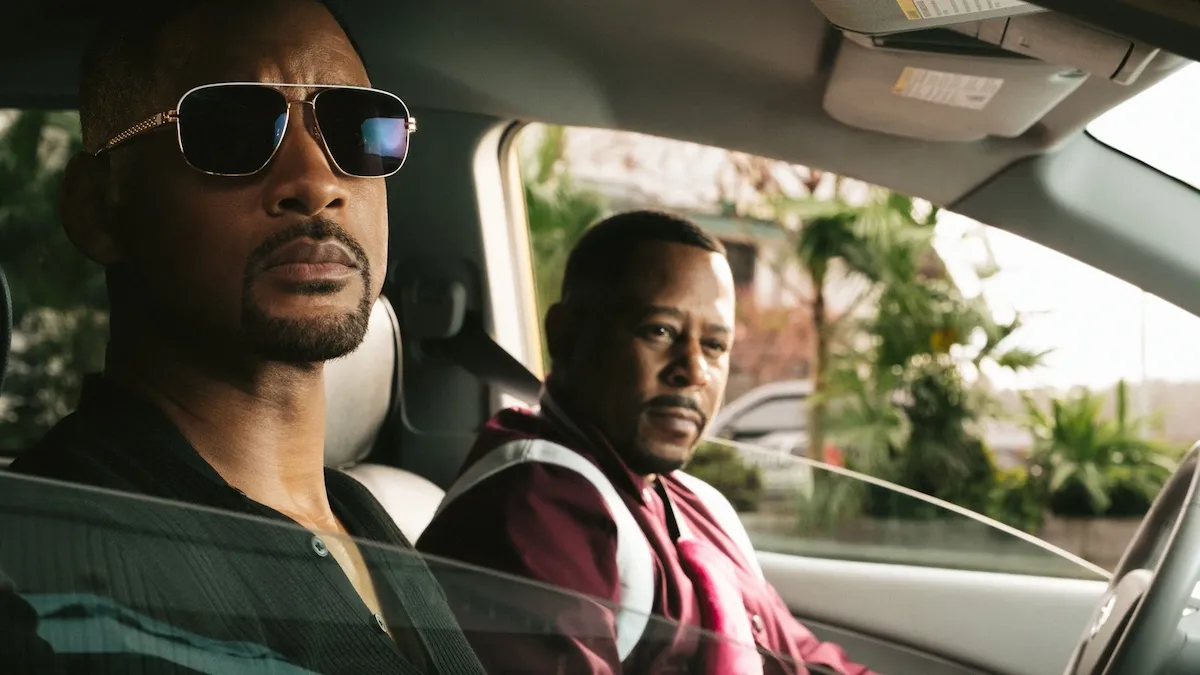
Bad Boys for Life, the third entry in the franchise, does something the first two did not: it lets its heroes change. Mike Lowrey and Marcus Burnett still drive through explosions, but the film gives them internal problems that the action cannot solve, and that shift is what makes it worth writing about.
Seventeen years separate this film from the previous one, and the gap is doing narrative work. The characters have aged in real time along with the audience, which means the film can be about ageing without having to invent a reason.
Marcus: duty against the life he wants
Marcus, known for his humour and his level head, arrives at a genuine turning point. In earlier films he mostly served as the comic counterweight to Mike. Here he faces a real dilemma: his duty as a police officer against his wish for a quiet family life.
That change gives him an emotional depth that makes him considerably less of a type. His evolution consists of recognising that his family is now the priority — which makes him more human and turns his arc into a straightforward story of personal growth. The film argues that heroism and family balance can coexist, and that a hero’s private life legitimately shapes what he does at work.
What makes it land is that Marcus wants to retire and the film treats that as a valid ending rather than a betrayal. Action cinema usually codes the desire to stop as cowardice or as a setup for a final job. Here it is simply what a man in his fifties with grandchildren might reasonably want.
Mike: from bravado to introspection
Mike remains the fearless version of himself, but the film exposes a difficult past that pushes him to question his role and his choices. His own demons surface, in direct contrast to the invincible image he had maintained.
This vulnerable version of Mike is what gives the story its emotional register. He now has to face both physical enemies and his own history, and that brings the two men closer: even the most reckless person in the room has fault lines. Their friendship strengthens as a result, showing that support is available in the worst moments — if you are willing to ask.
The film also asks a question the franchise had always avoided: what the job cost him. Mike has no family, no life outside the work, and the confidence that read as charisma at thirty reads at fifty as a series of avoided decisions. That is a serious observation for a film with this many car chases.
Friendship as the load-bearing structure
The partnership between Mike and Marcus is where the evolution is most visible. What was camaraderie built on humour becomes something closer to genuine emotional support, and it holds both of them up through their doubts.
The renewed dynamic makes a plain point: a hero’s strength includes the ability to look for help. By showing that even these two need assistance and can be vulnerable, the film puts weight on collaboration and mutual understanding — a personal growth that goes past the physical challenges and into the relationship itself.
The younger AMMO team provides the contrast that makes the argument work. They are better equipped, better trained and more methodical, and they are not better. What the two older men have is twenty-five years of knowing how the other thinks, which no equipment substitutes for.
Action that shares the frame with something else
Bad Boys for Life keeps the spectacular action the franchise is known for, and balances it with moments of vulnerability and reflection.
Foregrounding the characters’ internal struggles produces a more complex story in which action scenes are no longer the only source of tension. That is the depth the earlier films were missing, and it lets the audience identify with the characters and understand what their working lives actually cost them.
The film is a reminder that heroes have to evolve too, and that real strength often lies in the willingness to show weakness and support each other. It is what makes these two both more realistic and more genuinely inspiring than they were.
Three scenes worth rewatching
The opening drive. Two men in a car, one of them going to a birth rather than a shootout. The film establishes its whole thesis before anything happens.
Marcus’s promise. A quiet scene in a hospital corridor, and the moral spine of everything that follows.
The final confrontation. Notice how much of it is conversation. The franchise’s most violent film ends by trying to talk.
Language notes
Fast Miami dialogue, heavy on idiom and improvised comic exchanges, with some Spanish mixed in. Advanced level; intermediate learners should use English subtitles.
The Spanish is not subtitled in the original, and that is deliberate — Miami is a bilingual city and the film treats it as normal. For a Spanish speaker learning English, this is an unusual advantage: you get scenes where you understand a layer that most of the anglophone audience does not.
Expressions worth collecting:
- «Ride or die» — completely loyal, whatever happens; the film’s own tagline
- «Call it a day» — to stop working, either for the day or permanently
- «Have someone’s six» — military and police slang for covering someone’s back
- «Get one’s act together» — to organise yourself and start behaving responsibly