
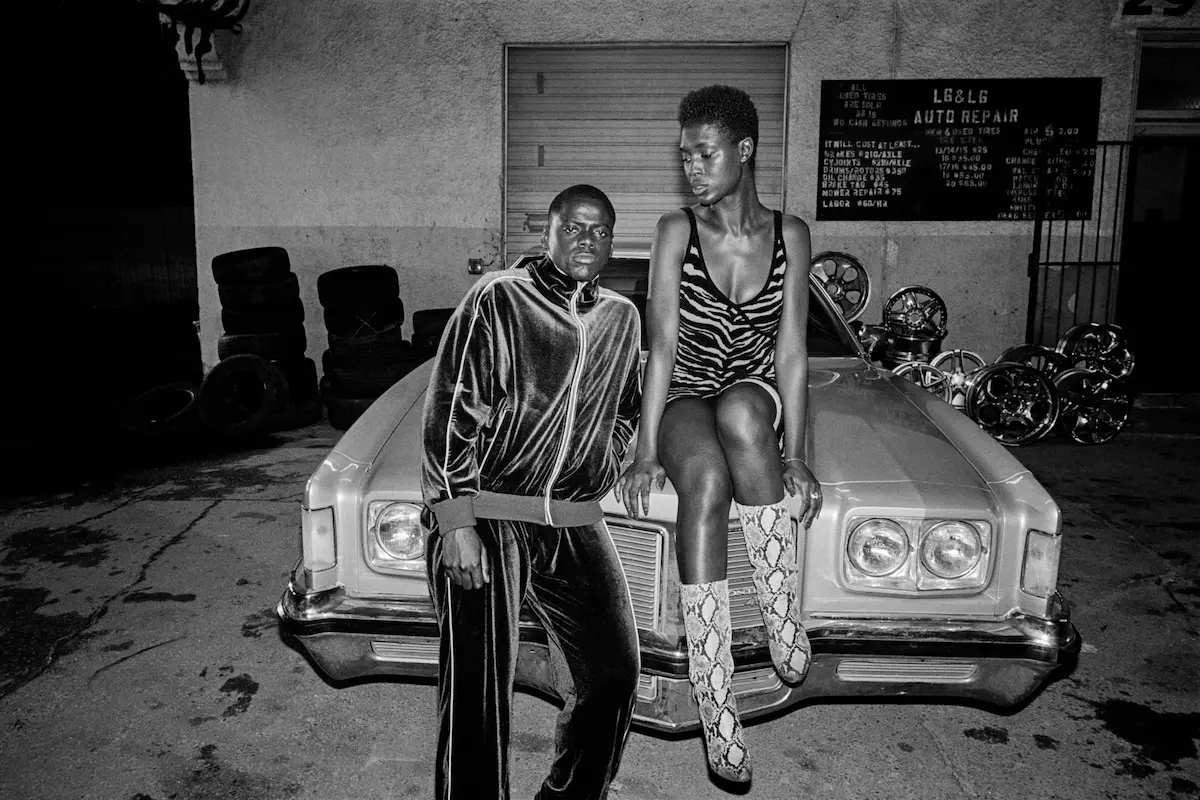
Queen & Slim, directed by Melina Matsoukas, is a film in which almost every image is doing narrative work. The story of a couple on the run after a traffic stop goes wrong is carried by its dialogue, but at least as much by what the camera chooses to show. Here is how the visual language supports the themes of freedom, love and injustice.
Matsoukas came from music video, and it shows in the best way: she is used to communicating a complete emotional argument in four minutes without relying on plot. Applied to a feature, that produces a film where you could follow the emotional line with the sound off.
Colour and light
Colour carries the emotional register throughout. Warm tones — red, orange — mark moments of tension and danger, but also of intimacy. The red lighting during the night Queen and Slim spend together is simultaneously sensual and threatening, which is an accurate description of their situation.
Cool tones do the opposite work, standing in for isolation and fear. The contrast between warm and cold across the film tracks the emotional swing the two characters are living through, and it lets the audience feel the shift before any line is spoken.
The film also uses colour to mark territory. The further south they travel, the warmer the palette becomes — which reads as safety and as danger at the same time, since the places most likely to shelter them are also the places with the longest histories of the violence they are fleeing.
Camera movement
Close-ups build a strong intimacy between the characters and the viewer, holding on raw emotion long enough for it to register. When Queen and Slim are alone in the car, the camera tightens on their faces, catching looks and expressions that carry the relationship.
Wide shots do something else entirely: they set the immensity of the landscape against the vulnerability of two people inside it. Those frames suggest freedom while underlining how insecure that freedom is. Following them across open country makes the beauty of what they are reaching for visible, and the precariousness of it unmistakable.
The camera is also careful about who it watches. The film consistently gives Queen and Slim the frame and refuses to grant the same attention to the people pursuing them, which is a political decision as much as an aesthetic one.
Location as meaning
The road runs through the whole film and stands for the search for freedom. It is both an escape from immediate danger and a metaphor for wanting out from under racial injustice. Every road scene shows how temporary that freedom is, with the authorities always somewhere behind them.
Enclosed spaces — the car, the houses where they shelter — produce the opposite feeling, a claustrophobia that stands for the limits imposed on them. Moving between open and closed spaces is how the film alternates between hope and despair, freedom and constraint, without stating either.
The car itself changes meaning as the film goes on. It begins as the site of the traffic stop, the most dangerous place either of them has been, and gradually becomes the only place they are safe. That inversion is achieved entirely through framing and light.
Why the aesthetics matter
The visual beauty of the film pushes the audience toward empathy, and toward the racial injustice the characters are living. Setting the beauty of the landscape against the harshness of their circumstances creates a juxtaposition that is difficult to look away from.
Matsoukas’s choices — colour, camera, location — tell a story that goes beyond the script, and they reinforce the film’s central concern with dignity and justice in an oppressive society. The strength of visual storytelling is exactly this: it conveys emotion and raises questions without needing to say anything.
Queen & Slim is a strong argument that the image itself can carry meaning, and it makes the film a genuinely useful model of cinematic narration.
Three scenes worth rewatching
The diner, before anything happens. A first date that is not going especially well. Everything the film later depends on is established here, in ordinary conversation.
The traffic stop. Shot with almost no cuts and no music. The absence of stylisation is the choice, and it makes the scene unbearable in the way it needs to be.
The juke joint. Intercut with a protest elsewhere. Two forms of Black public life placed side by side, with the film declining to rank them.
Language notes
African-American Vernacular English and Southern accents, delivered naturally. Challenging listening; advanced level, or intermediate with English subtitles.
AAVE is a rule-governed variety with its own consistent grammar, not an approximation of standard English, and the film uses it throughout without explanation. For a learner, the value is exposure to a major variety of English that classroom material almost never covers — and the recognition that «correct English» is a narrower idea than it is usually presented as.
Expressions worth collecting:
- «On the run» — fleeing from the authorities, or more loosely, extremely busy
- «Lay low» — to stay out of sight until a situation calms down
- «Have someone’s back» — to support and protect someone, especially at cost to yourself
- «Pull someone over» — for police to stop a vehicle; the phrasal verb the whole film turns on