Watching to learn works — and better than most people expect. There are films for every level, from the complete beginner getting used to the sounds of English to the intermediate learner sharpening comprehension. The right film turns an evening into a study session without it feeling like one. Here is our selection of ten films to watch to improve your English, with the practical advice that makes the difference.
How films actually help you learn English
Learning a language through film is learning in context. Unlike a textbook, a film exposes you to English as it is really spoken: with its contractions, its informal turns of phrase, its cultural references. The easiest way to learn a language is to make it enjoyable — and watching in the original version is one of the most natural ways to do that.
Films help on several fronts at once:
- Listening comprehension, by hearing dialogue in its natural context rather than in a recording made to be understood.
- Vocabulary, through expressions textbooks do not teach.
- Pronunciation, by exposing you to the real rhythm and intonation of the language.
- Speaking, more naturally, because you internalise structures through repetition rather than memorising them.
Learners who watch regularly progress faster on listening than those doing decontextualised exercises. It is also the most reliable way to make learning last, because enjoyment is what keeps people coming back.
Watching films in English: the habits that make the difference
Watching is not enough on its own — you have to watch actively.
Rewatch the difficult scenes. If you missed the dialogue, play it again with English subtitles, then without. The words become familiar and the ear adjusts.
Write down the expressions that recur. Every film is a source of contextual vocabulary: the dialogue shows how phrases are actually used, not how a glossary says they should be.
Use series at the same rhythm as films. Dialogue repeats from one episode to the next, which reinforces memorisation without effort.
Watch in the original version from the very beginning — even with subtitles in your own language. It accustoms the ear to the accent and pace of everyday English long before you can follow it fully.
Choosing a film for your level, beginner or advanced
Choosing a film that matches your level is the whole game. A film that is too hard discourages; one that is comfortably within reach builds confidence.
If you are a beginner: go for children’s films or comedies with simple dialogue. The English is articulated and slow — ideal for learning without being overwhelmed. Try Toy Story, Frozen or The Lion King.
Intermediate: romantic comedies and contemporary dramas. The dialogue is faster and more idiomatic, but the context stays accessible.
Advanced: historical films, political thrillers, or dramas with dense dialogue. Accents vary between characters and the vocabulary is far richer.
The natural progression is: subtitles in your own language, then English subtitles, then none at all.
English subtitles: how and when to use them
Subtitles are the most powerful tool available — provided you use them deliberately.
Subtitles in your own language (beginner): you follow the story and get used to the sounds of English without getting lost. That is step one, and there is no shame in it.
English subtitles (intermediate): you read what you hear. That double processing, auditory and visual, accelerates vocabulary and pronunciation, and lets you catch the words your ear misses.
No subtitles (advanced): you test your real listening comprehension. If you follow more than 80% without reading, your level allows it.
Subtitles must not become a crutch. The end goal is watching without reading — and you get there one film at a time.
Accents in film: British, American, and the ones in between
Accent is one of the reasons watching in the original version works so well.
American English dominates Hollywood productions. Standard and clearly articulated, it is the most accessible for learners and the one most often taught.
British English — BBC productions, prestige films, period drama — exposes the ear to something quite different in pronunciation and rhythm. The actors in those productions are the best models available for learning it by immersion.
Other accents — Australian, Irish, South African — appear in plenty of well-known films. For advanced learners, meeting them improves overall comprehension far more than pronunciation drills do.
The ten best films to watch to learn English
Here are the ten, sorted by level — all from the e-dutainment catalogue and available directly on the platform. The point of this selection is that you will actually want to watch them again.
🎬 Beginner
1. Dolittle (2020)
The right film when you are starting out. Robert Downey Jr. speaks a very clearly articulated American English, with short lines and deliberately expressive delivery. The exchanges with the animals are easy to follow and the vocabulary stays simple.
2. How to Train Your Dragon: The Hidden World (2019)
One of the most effective family films in the catalogue for learning. The dialogue has rhythm, the pace is slow, and the characters articulate carefully. You concentrate on sounds and pronunciation without trying to catch everything.
3. Back to the Future (1985)
A film most learners already know — which is exactly the point. When you know what happens next, you can give your full attention to the dialogue, the accent and the pronunciation. Marty McFly’s English is current and natural, with no difficult slang.
🎬 Intermediate
4. Forrest Gump (1994)
An excellent film for American English in all its variety. Forrest speaks slowly and simply; the other characters bring richer registers and deep cultural references. You work on listening and emotional vocabulary at the same time.
5. Catch Me If You Can (2002)
Leonardo DiCaprio plays a character who imitates different accents and professions to pass for someone he is not — a neat mirror of language learning itself. The dialogue is clear, the pace brisk, and the short exchanges are ideal for pronunciation work.
6. The Hustle (2019)
Several accents in a single viewing. Anne Hathaway (American English) and Rebel Wilson (Australian English) in a light, accessible con comedy. Meeting more than one variety of English at intermediate level is one of the best ways to build a flexible ear.
7. Mission: Impossible – Fallout (2018)
For learners who want professional English under pressure. Tom Cruise in American English, Simon Pegg in British English: two accents in an action film with an intense rhythm, and real phonetic range across the cast.
🎬 Advanced
8. The Social Network (2010)
Dense, fast dialogue with very current tech and business vocabulary. Aaron Sorkin writes exchanges that play at almost impossible speed: following them without English subtitles is a genuine test of level.
9. Once Upon a Time in Hollywood (2019)
Brad Pitt and Leonardo DiCaprio in 1960s American English. Tarantino’s dialogue seems slow but is lexically exceptional — precise, idiomatic, full of turns of phrase no textbook teaches.
10. The Godfather (1972)
The reference film for American English. Marlon Brando, Al Pacino, James Caan — iconic dialogue, slow, precise, dramatically dense. Learning English from the best actors of the twentieth century is what this film offers better than any other.
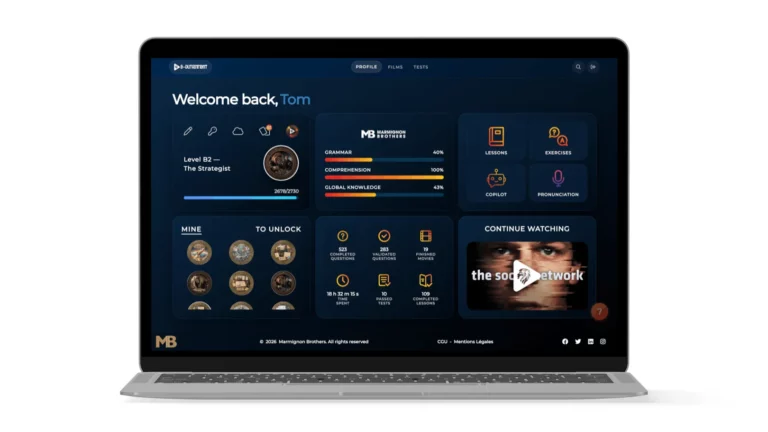
All ten are in the e-dutainment catalogue — available on the platform with exercises, dialogue quizzes and progress tracking.
Your favourite film is probably your best teacher
The best film for learning English is usually the one you already want to rewatch. You know the story, so you can give your whole attention to the dialogue, the accent, the pronunciation.
Want it to stick? Start with a film you genuinely like, and watch it several times — with English subtitles, then without — until the dialogue feels natural. Learning at your own pace is what makes the progress hold.
Learning English with e-dutainment: the method behind the films
At e-dutainment, learning through film is not a gimmick — it is the foundation of the method. Every programme is built on films, authentic dialogue and real situations, so that learning feels as natural as watching a film at home.
The voices and accents of the actors — American, British, Australian — become your pronunciation models. The films are integrated into learning paths matched to your level and your objectives.
→ Discover our online English programmes and learn English through films with the e-dutainment method.
Sources and references
- Teaching source: Learning resources developed by Marmignon Brothers for the e-dutainment app and the English training courses offered by the organisation.