
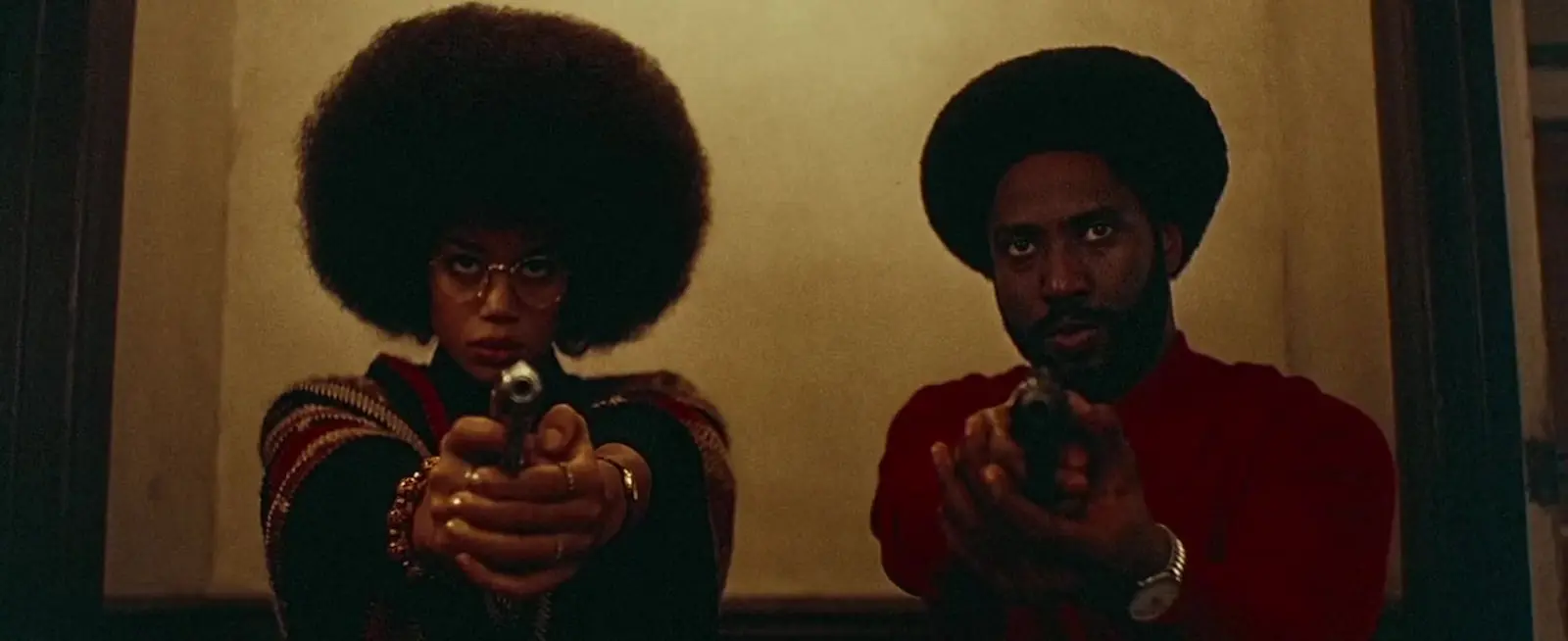
BlacKkKlansman, directed by Spike Lee, is more than a film about racism and the civil rights struggle. It is a sociopolitical commentary on America then and now. Based on a true story, it follows Ron Stallworth, the first African-American police officer in Colorado Springs, as he infiltrates the Ku Klux Klan — and through that story Lee works on racism, identity and resistance.
Systemic racism
Racism runs through the film at every level. It appears in the explicit actions of the Klan, but also in the attitudes and institutions that hold the surrounding society together. Lee shows how it saturates social structures and shapes both personal and professional relationships.
Stallworth navigates an environment that is frequently hostile to him. His phone calls with the Klan, in which he passes for white, expose both the absurdity and the cruelty of the thing. Those scenes make the mechanism visible: racial prejudice dehumanises people of colour, and inequality is what it reproduces.
The telephone premise is the film’s sharpest structural idea. If a Black man can be accepted as a Klan member simply by speaking a certain way, then the category the Klan is defending was never coherent to begin with. The joke and the argument are the same thing.
Identity and belonging
Identity is the film’s other subject. Stallworth is continuously balancing two roles — a police officer and a Black man in a racist society — and the film examines how racial identity shapes what happens to a person at work and outside it.
One scene holds the whole conflict: attending a Klan gathering in police uniform, he embodies authority and resistance at the same time. Lee uses the image to ask what it means to be Black in a society that uses identity as a dividing instrument, and offers no comfortable answer.
The film complicates this further through Flip Zimmerman, the Jewish colleague who plays Stallworth in person. Flip has never thought of himself as anything other than a regular cop, and infiltrating the Klan forces him to confront an identity he had been able to ignore. The two men are having the same experience from opposite starting points — one who was never allowed to forget, and one who had the option.
Resistance and inheritance
The film does not stop at denunciation. It also honours the resilience and activism of the African-American community. Through characters like Patrice, an organiser, it shows that resistance is broader than direct confrontation — it runs through dialogue, education and solidarity.
Patrice also functions as the film’s argument against Stallworth. Her position is that the institution cannot be reformed from inside, and the film does not settle the disagreement. Giving the most coherent critique to the person who disagrees with your protagonist is a mark of seriousness.
Lee anchors the story in a specific history, connecting past struggles to present ones. Archive footage and references to real events, including Charlottesville, work as a reminder that racism has not been left behind, and as a call for collective awareness. That link between then and now is what makes the film ask the audience about its own role rather than only about the past.
Why it lands
BlacKkKlansman takes on complicated material and manages to be rooted in history while speaking directly to the present. Its argument is that the fight against racism is unfinished, and that identity is not a label but something dynamic and continuously in motion.
By pushing viewers to examine their own beliefs and assumptions, the film asks for an active part in building a fairer society. Resistance and solidarity — the two things it keeps returning to — remain the working conditions for any durable social justice.
Three scenes worth rewatching
The first phone call. Stallworth using his own name with the Klan, entirely by accident. The film’s plot and its central joke are established in ninety seconds.
The cross-cut initiation. A Klan ceremony intercut with an elderly civil rights witness describing a lynching. Two ceremonies, one edit; it is the most controlled sequence in the film.
The final minutes. The shift from fiction to documentary footage. The film stops being a period piece in front of you, which is precisely the intended effect.
Language notes
1970s American English with strong regional and social variation, plus period slang. Demanding but rewarding; advanced level, or intermediate with English subtitles.
The film is unusually explicit about how English carries social information. Stallworth describes consciously switching between what he calls «King’s English» and Black vernacular, and the plot depends on that ability. For a language learner, this is a rare chance to hear register described and demonstrated in the same film.
A warning: the dialogue includes a great deal of racist language, used to portray racism rather than endorse it. It is central to what the film is doing and it is genuinely difficult to sit through.
Expressions worth collecting:
- «Pass for» — to be accepted as something you are not; the mechanism of the entire plot
- «Undercover» — operating with a concealed identity, in policing and by extension elsewhere
- «Blow someone’s cover» — to accidentally reveal a concealed identity
- «Wake up» — used politically to mean becoming aware of injustice; the origin of a much later and much-debated term